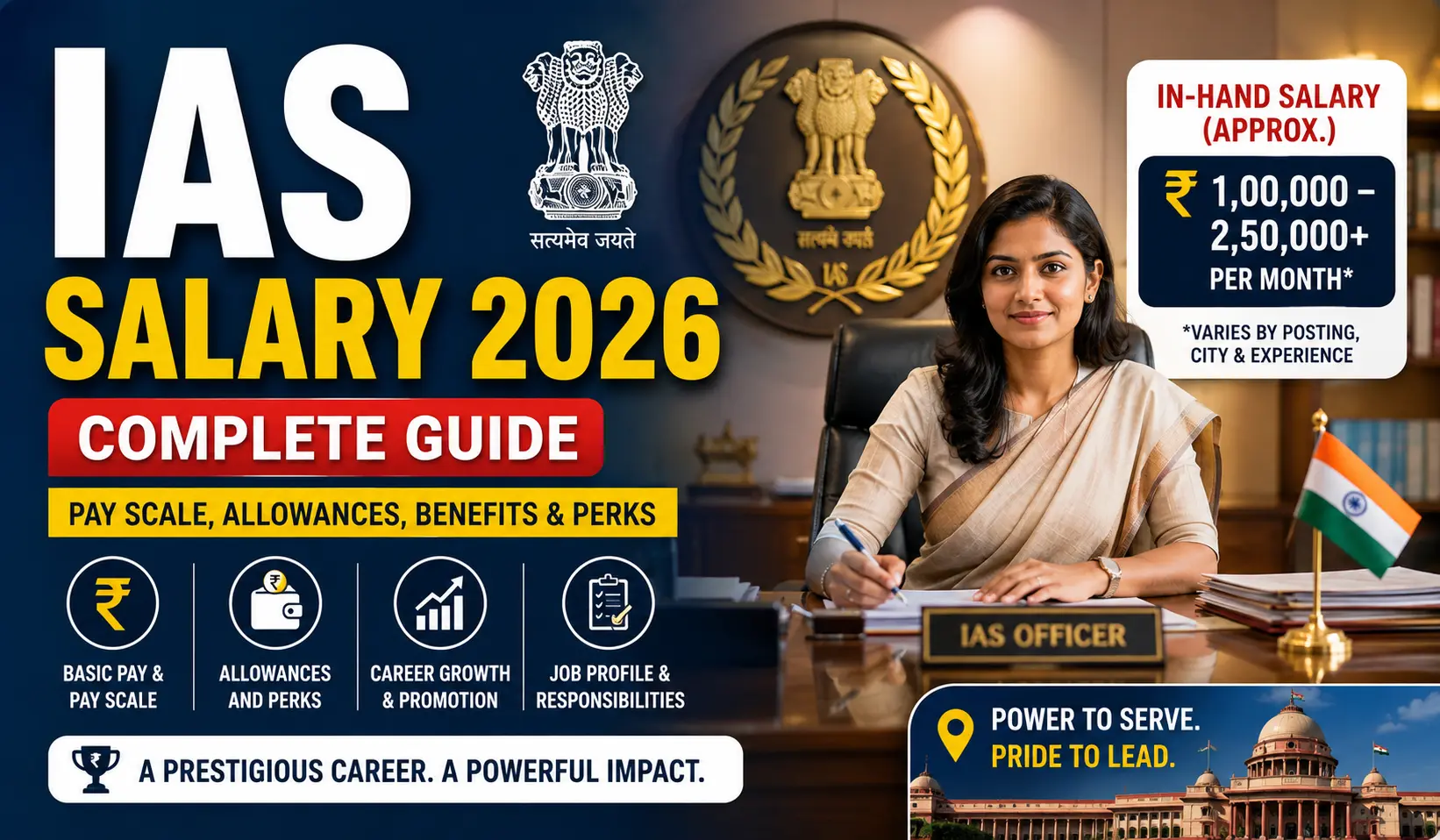
The Indian Administrative Service (IAS) is one of India’s All India Services and forms a major part of the country’s administrative system. IAS officers work in district administration, state governments, central ministries and other public-sector assignments.
The attraction is not only the monthly pay. The career offers responsibility, structured progression, government benefits and opportunities to work on public policy and administration.
This guide explains the 2026 pay structure, current allowances, location-related differences, promotion-linked pay levels, deductions, benefits and the route through the UPSC Civil Services Examination.
Who Is an IAS Officer?
An IAS officer is a senior government administrator who may handle district administration, revenue matters, development programmes, public policy, disaster management, departmental administration and implementation of government schemes.
The service is administered under the Department of Personnel and Training (DoPT) and the IAS Pay Rules. Officers can serve under state governments or the Union government and can also be placed on deputation to other organisations. That does not turn IAS into a conventional private-sector job with market-based salaries.
For this reason, this article treats IAS as a government-sector career only. A separate private-sector salary table would be misleading.
Government Sector IAS Salary Structure
IAS officers are paid under the IAS Pay Rules, 2016, using designated levels in the 7th Central Pay Commission pay matrix. A direct-recruit IAS officer enters at Level 10, with a basic pay of ₹56,100 per month.
The figures below are basic pay, not take-home salary.
| IAS grade/pay level | Starting basic pay | Pay-matrix ceiling / fixed pay | Career stage |
| Level 10 | ₹56,100 | ₹1,77,500 | Entry level |
| Level 11 | ₹67,700 | ₹2,08,700 | Senior Time Scale |
| Level 12 | ₹78,800 | ₹2,09,200 | Junior Administrative Grade |
| Level 13 | ₹1,23,100 | ₹2,15,900 | Selection Grade |
| Level 14 | ₹1,44,200 | ₹2,18,200 | Super Time Scale |
| Level 15 | ₹1,82,200 | ₹2,24,100 | Higher administrative level |
| Level 17 | ₹2,25,000 | ₹2,25,000 | Apex Scale |
| Level 18 | ₹2,50,000 | ₹2,50,000 | Cabinet Secretary Grade |
The IAS-specific levels and progression framework are prescribed by the Department of Personnel and Training. Level 17 is the Apex Scale, while Level 18 is reserved for the Cabinet Secretary grade.
Current DA and HRA
Basic pay is only one part of an officer’s compensation. Dearness Allowance (DA) is revised periodically rather than remaining fixed for the entire year.
The latest official DA order I could verify for 2026 increased DA for Central Government employees from 58% to 60% of basic pay, effective January 1, 2026.
For All India Services officers, the government has confirmed that the accepted 7th CPC provisions relating to HRA and certain other allowances apply to AIS officers. The central HRA framework provides 30% for X-class cities, 20% for Y-class cities and 10% for Z-class cities when DA exceeds 50%.
For an officer at the entry basic of ₹56,100, the following illustrates the effect:
| Component | X-class location | Y-class location | Z-class location |
| Basic pay | ₹56,100 | ₹56,100 | ₹56,100 |
| DA at 60% | ₹33,660 | ₹33,660 | ₹33,660 |
| HRA rate | 30% | 20% | 10% |
| HRA amount | ₹16,830 | ₹11,220 | ₹5,610 |
| Basic + DA + HRA subtotal* | ₹1,06,590 | ₹1,00,980 | ₹95,370 |
*Calculated from the official ₹56,100 Level-10 basic, 60% DA and applicable HRA rates. This is not take-home pay and does not include all other admissible allowances or deductions.
Pay Variation by Location
IAS basic pay does not change simply because an officer moves from one city to another. The major location-related difference comes from allowances.
HRA depends on the classification of the posting location. Official rules also provide for different treatment where government accommodation or other applicable housing arrangements are involved.
| Location factor | Effect on compensation |
| X-class city | Highest standard HRA rate |
| Y-class city | Mid-level HRA rate |
| Z-class city | Lower HRA rate |
| Government accommodation | HRA entitlement can be affected by accommodation rules |
| State/cadre posting | Allowances can depend on the applicable AIS/state rules |
| Central deputation | Additional deputation-related conditions may apply |
Location can therefore change monthly gross earnings even when the officer’s basic pay remains unchanged.
IAS Salary Comparison by Career Level
Because IAS has no private-sector equivalent salary structure, the most useful comparison is between stages of the same career.
| Career stage | Pay level | Starting basic pay |
| Entry IAS officer | Level 10 | ₹56,100 |
| Senior Time Scale | Level 11 | ₹67,700 |
| Junior Administrative Grade | Level 12 | ₹78,800 |
| Selection Grade | Level 13 | ₹1,23,100 |
| Super Time Scale | Level 14 | ₹1,44,200 |
| Higher administrative level | Level 15 | ₹1,82,200 |
| Apex Scale | Level 17 | ₹2,25,000 |
| Cabinet Secretary Grade | Level 18 | ₹2,50,000 |
These are pay-matrix figures, not guaranteed monthly take-home amounts.
Career Progression and Advancement Path
IAS progression is structured around service length, suitability, vacancies and the applicable promotion rules. The IAS Pay Rules specify eligibility for successive grades at defined service milestones.
An officer becomes eligible for the Senior Time Scale after four years, the Junior Administrative Grade after nine years, the Selection Grade after 13 years, and the Super Time Scale after 16 years, subject to the applicable conditions.
A simplified progression looks like this:
UPSC selection → Level 10 → Senior Time Scale → JAG → Selection Grade → Super Time Scale → HAG/Apex-level responsibilities
These are eligibility milestones, not promises that every officer will immediately receive a particular post or assignment. Actual career progression also depends on service rules, performance, cadre requirements and available posts.
DoPT continues to run mandatory mid-career training programmes for IAS officers, including Phase III, IV and V programmes in 2026.
Benefits and Perks
The value of the career extends beyond basic pay.
Housing-related benefits
Eligible officers can receive HRA according to the applicable AIS rules and posting conditions. Government accommodation may also be available in appropriate circumstances, subject to availability and rules.
Medical facilities
All India Services have dedicated medical-attendance rules. Depending on where and in what capacity an officer serves, medical benefits are provided under the applicable AIS or government health framework.
Leave and travel
IAS officers are covered by All India Services leave rules and Leave Travel Concession provisions. The LTC rules distinguish between officers serving in connection with Union and State affairs while preserving the applicable entitlement under the rules.
Retirement benefits
Retirement arrangements for newer government entrants are linked to the NPS framework, with the Unified Pension Scheme (UPS) available as an option for eligible Central Government employees under NPS. PFRDA states that UPS became effective from April 1, 2025.
PFRDA also lists dedicated AIS NPS Rules 2026, showing that retirement arrangements for All India Services continue to be governed by specific rules.
Deductions and Take-Home Considerations
The amount credited to an IAS officer’s bank account will be lower than the total of basic pay and allowances.
Common factors include:
- Income tax and applicable cess
- NPS/UPS-related employee contribution, depending on the applicable retirement option and rules
- Other authorised recoveries or deductions
- Government accommodation or related charges where applicable
- Insurance or other employee-specific deductions
For the 2026–27 assessment year, the Income Tax Department lists the new tax regime as the default regime for individuals, with slabs beginning at nil tax up to ₹4 lakh and rising progressively to 30% above ₹24 lakh. A rebate of up to ₹60,000 is available under Section 87A for eligible taxpayers with total income up to ₹12 lakh.
Tax should therefore not be calculated simply by applying one percentage to the officer’s monthly salary. The taxable income, applicable regime, deductions and other income all matter.
For retirement contributions, PFRDA’s Central Government NPS framework specifies employee contributions of 10% of basic pay plus DA and a 14% government contribution for covered Central Government employees; UPS has its own contribution and benefit framework. IAS officers should follow the specific AIS rules applicable to their appointment and retirement option.
How to Become an IAS Officer
The standard route is the UPSC Civil Services Examination (CSE).
For CSE 2026, UPSC issued the notification on February 4, 2026. The Preliminary Examination was scheduled for May 24, 2026.
The broad route is:
- Complete a recognised bachelor’s degree or equivalent qualification.
- Meet the nationality, age and other UPSC eligibility requirements.
- Apply for the UPSC Civil Services Examination.
- Clear the Preliminary Examination.
- Qualify in the Main Examination.
- Appear for the Personality Test/Interview.
- Secure a sufficiently high final rank and indicate IAS as a service preference.
- Complete the required training and join the allotted cadre.
For CSE 2026, the standard age requirement was 21 to 32 years as of August 1, 2026, with relaxations for eligible categories.
A bachelor’s degree is the core educational requirement. The UPSC notification also permits eligible final-year candidates to appear subject to the prescribed conditions for producing proof of qualification.
The competitive part is important: passing the examination alone does not guarantee IAS allocation. Final service allocation depends on rank, preferences, vacancies and the applicable allocation rules.
What About the 8th Pay Commission?
The 8th Central Pay Commission has been constituted, so candidates researching future government pay should be careful with online salary calculators and social-media claims.
The official 8th CPC website shows that the Commission was constituted in November 2025 and is conducting consultations and visits during 2026.
However, there is no officially notified new IAS pay matrix that should replace the current 7th CPC figures in this guide. The government has stated that the Commission has 18 months to make recommendations, while the final implementation decision will be taken by the Government.
That means figures such as a supposed “new IAS basic salary” based on an unannounced fitment factor should not be presented as confirmed 2026 pay.
Which Career Path Should You Choose? — Honest Take
IAS is financially attractive, but the headline basic pay is only part of the decision. The bigger advantages are structured progression, public-sector benefits, administrative authority and the breadth of assignments available during a long career.
The trade-off is the demanding selection process and the nature of the work itself. Transfers, public accountability, political and administrative pressures, emergency duties and long working hours can affect work-life balance. For someone primarily motivated by rapid income growth, a private-sector career may eventually offer faster compensation growth; for someone seeking public administration and long-term government service, IAS can be a strong fit.
FAQs
1. What is the starting basic pay for an IAS officer in 2026?
A directly recruited IAS officer starts at ₹56,100 per month in Level 10 of the 7th CPC pay matrix. This is basic pay and does not represent take-home salary.
2. How much does an IAS officer receive after allowances?
The amount varies by posting and personal circumstances. With the latest verified 60% DA and the applicable HRA rates, an entry-level officer’s basic-plus-DA-plus-HRA subtotal can be approximately ₹95,370 to ₹1,06,590 per month, before other allowances and deductions.
3. Does IAS salary increase automatically with experience?
Basic pay rises through annual increments within the applicable pay level, while progression to higher grades can move an officer into higher pay levels. The IAS rules specify service-based eligibility milestones, but posting and promotion outcomes are subject to the relevant rules and conditions.
4. Is there a private-sector IAS salary?
No. IAS is an All India Service under the government system. An IAS officer can serve on deputation to other organisations, including public-sector bodies, but this does not create a standard private-sector IAS career with market salary bands.
5. Is the 8th Pay Commission salary included in the 2026 figures?
No. The 2026 figures in this guide use the existing IAS 7th CPC pay structure. The 8th CPC is active, but its final recommendations and government implementation decision should not be treated as an already-notified IAS salary revision.
6. What exam is required to become an IAS officer?
The standard route is the UPSC Civil Services Examination. Candidates must clear the required stages and obtain a final rank and service allocation that results in appointment to IAS. UPSC’s official 2026 examination page confirms the current CSE cycle and its examination schedule.
Conclusion
The 2026 IAS compensation structure remains based on the 7th CPC pay matrix, with ₹56,100 basic pay at entry in Level 10 and substantially higher pay levels available as officers progress through the service. DA, HRA and other admissible benefits can significantly change the overall package, while taxes and retirement contributions reduce the final amount credited to the officer.
For anyone considering this career, the financial package is only one part of the equation. The UPSC selection process, administrative responsibility, transfers and long-term public-service commitment should be weighed alongside the pay and benefits.