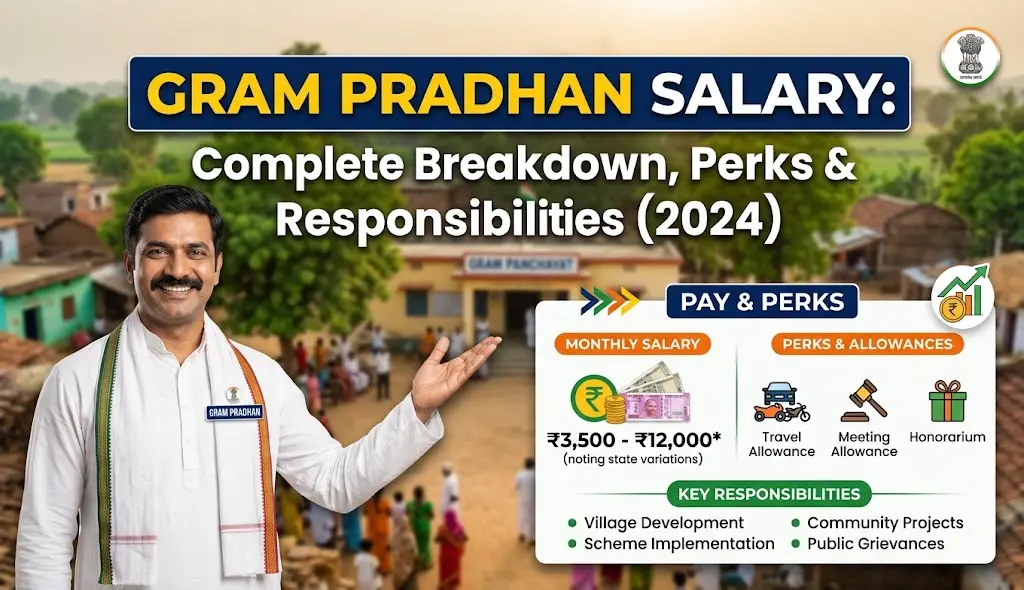
A Gram Pradhan (also called Sarpanch, Mukhiya, or Village Panchayat President in some states) is the elected head of a Gram Panchayat and plays a key role in rural governance. Unlike regular government employees, Gram Pradhans are generally not paid a salary under a government pay scale. Instead, they receive an honorarium (मानदेय) determined by their respective state government.
Because Panchayati Raj is a State Subject under the Constitution of India, compensation varies significantly from one state to another. Some states provide modest monthly honoraria, while others offer additional allowances or sitting fees. This guide explains the latest available pay structure, benefits, deductions, eligibility, and career prospects for aspiring village leaders.
Who Is a Gram Pradhan?
A Gram Pradhan is the elected head of a village Gram Panchayat. The position exists within India’s local self-government system established under the Panchayati Raj framework.
Typical responsibilities include:
- Supervising village development projects
- Conducting Gram Sabha meetings
- Managing local infrastructure initiatives
- Monitoring welfare schemes
- Coordinating with Block and District Panchayat officials
- Representing village concerns before government authorities
The role exists exclusively in the local government sector. There is no private-sector or public-sector equivalent of a Gram Pradhan.
Government Sector Salary Structure
Is a Gram Pradhan a Government Employee?
No. A Gram Pradhan is an elected public representative, not a regular government employee. Therefore, they do not receive:
- Pay Commission salary levels
- Dearness Allowance (DA)
- House Rent Allowance (HRA)
- Regular government pension benefits
Instead, they receive a state-determined honorarium.
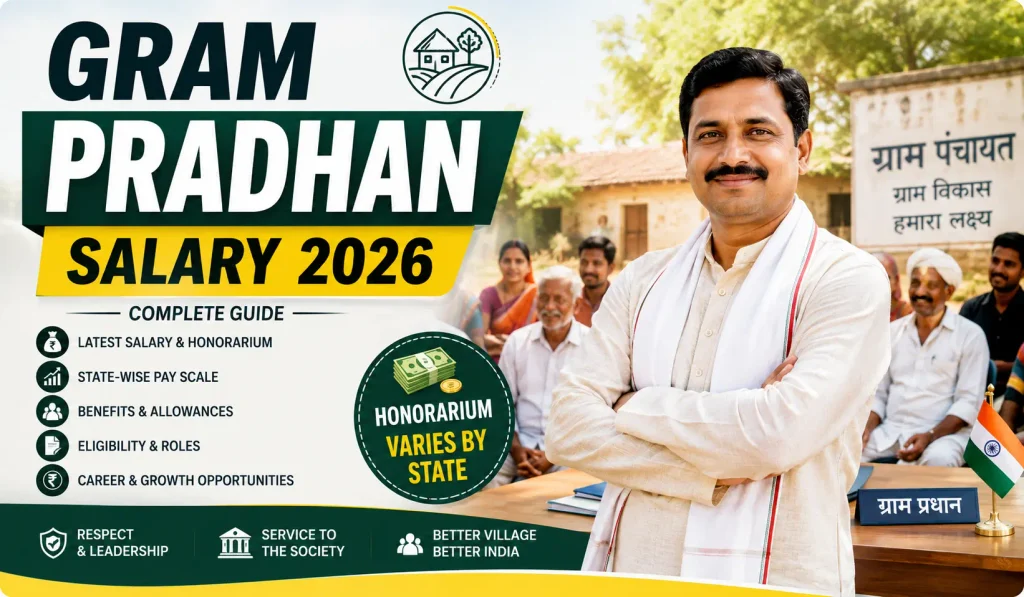
Gram Pradhan Salary Structure 2026
| Component | Amount |
| Basic Salary | Not Applicable |
| Monthly Honorarium | State-specific |
| DA | Not Applicable |
| HRA | Not Applicable |
| Pension | Generally Not Available |
| Travel Allowance | May be available in some states |
| Sitting Fees | Available in certain states |
| Tenure | Usually 5 years |
Source: Ministry of Panchayati Raj and State Panchayati Raj Departments.
State-Wise Gram Pradhan Honorarium (Latest Available Data)
Since India has no nationwide pay scale for elected Panchayat representatives, compensation varies by state.
| State | Monthly Honorarium |
| Uttar Pradesh | ₹5,000 per month |
| Himachal Pradesh | ₹7,500 per month (2025 revision) |
| Rajasthan | Around ₹5,000 per month* |
| Maharashtra | ₹5,000–₹7,000 per month* |
| Gujarat | ₹5,000–₹8,000 per month* |
| Kerala | ₹8,000–₹10,000 per month* |
| Bihar | ₹2,000–₹3,500 per month* |
| Karnataka | ₹3,000–₹5,000 per month* |
*State-wise figures may be revised periodically by state governments. Verify with the latest Panchayati Raj Department notification before relying on them.
Pay Variation by Location
Because honorarium is controlled by state governments, location significantly affects compensation.
| State | Typical Monthly Payment |
| Kerala | Higher end of national range |
| Gujarat | Above average |
| Himachal Pradesh | Above average |
| Uttar Pradesh | Moderate |
| Bihar | Lower range |
| West Bengal | Lower to moderate range |
The size of the Gram Panchayat, village population, state budget allocations, and policy revisions can influence the final amount paid.
Comparison Table: Gram Pradhan vs Other Panchayati Raj Positions
| Position | Typical Monthly Honorarium |
| Gram Panchayat Member | Sitting fee or small honorarium |
| Up-Pradhan / Deputy Pradhan | Lower than Pradhan |
| Gram Pradhan | ₹2,000–₹10,000 depending on state |
| Panchayat Samiti Chairperson | Usually higher |
| Zila Parishad Chairperson | Significantly higher |
For example, Himachal Pradesh provides ₹7,500 monthly to Gram Pradhans, while Zila Parishad Chairpersons receive ₹25,000 monthly.
Career Progression and Advancement Path
Unlike traditional government jobs, Gram Pradhan is an elected position rather than a promotional hierarchy.
Typical progression may look like:
| Stage | Route |
| Gram Panchayat Member | Local election |
| Up-Pradhan | Elected within Panchayat |
| Gram Pradhan | Direct election |
| Panchayat Samiti Member | Local body election |
| Block Pramukh | Indirect election |
| Zila Panchayat Member | District-level election |
| MLA / MP | Political advancement |
Advancement depends on electoral success, leadership reputation, public support, and political involvement.
Benefits and Perks
Although compensation is modest, Gram Pradhans may receive several non-salary benefits depending on state rules.
Common Benefits
- Official recognition as village head
- Administrative authority within Panchayat limits
- Participation in government development programs
- Reimbursement of approved official expenses
- Training under Panchayati Raj schemes
- Access to leadership-development programs under Rashtriya Gram Swaraj Abhiyan (RGSA)
Important Note
These benefits vary significantly between states and should not be assumed nationwide.
Deductions and Take-Home Considerations
Income Tax
Honorarium received by a Gram Pradhan may be taxable depending on total annual income and other earnings.
Income tax liability is governed by the Income Tax Act and the applicable tax regime chosen by the taxpayer.
Source: Income Tax Department of India.
Social Security Contributions
Unlike regular government employees, Gram Pradhans generally do not receive:
- EPF contributions
- NPS contributions
- Government pension accumulation
This means there are usually no standard employee retirement deductions from the honorarium.
Other Deductions
Potential deductions may include:
- Professional tax (where applicable)
- Income tax deductions
- Recovery of overpayments, if ordered by authorities
Actual take-home earnings are often very close to the honorarium amount because the payment itself is relatively modest.
How to Become a Gram Pradhan
The position is filled through elections rather than recruitment exams.
Eligibility Requirements
Generally, candidates must:
- Be an Indian citizen
- Be registered as a voter in the relevant Panchayat area
- Meet the minimum age requirement (usually 21 years)
- Satisfy state-specific eligibility conditions
- Avoid disqualifications specified under state Panchayat laws
Selection Process
- Election notification issued
- Nomination filing
- Scrutiny of nominations
- Campaign period
- Public voting
- Declaration of results
In Uttar Pradesh, Gram Pradhans are elected directly by village voters.
Is There Any Exam?
No.
Unlike SSC, UPSC, or State PSC jobs, there is no written examination for becoming a Gram Pradhan.
Should You Pursue This Role?
If your primary goal is earning a high monthly income, this position may not be ideal. Honorarium levels remain relatively modest compared with government jobs or private-sector careers.
However, for individuals interested in public service, grassroots leadership, local politics, and village development, the role offers significant influence and community impact. Many politicians begin their careers in Panchayati Raj institutions before advancing to district, state, or national politics.
The biggest advantage is local leadership experience. The biggest drawback is the relatively low financial compensation.
FAQs
What is the Gram Pradhan salary per month in 2026?
In most states, monthly honorarium ranges from approximately ₹2,000 to ₹10,000, depending on state government policies.
Is a Gram Pradhan a government employee?
No. A Gram Pradhan is an elected representative, not a regular government employee.
Does a Gram Pradhan receive pension benefits?
Generally, no regular pension scheme similar to government employees is available. Benefits depend on state-specific rulesWhich state pays the highest honorarium?
Recent publicly available reports indicate Kerala and some other states provide among the highest honorarium levels, though figures are subject to revision.
Is there any qualification requirement?
Educational requirements vary by state. The core requirement is eligibility under the respective state’s Panchayati Raj Act.
Can a Gram Pradhan become an MLA?
Yes. Many politicians begin at the Panchayat level and later contest elections for higher offices such as Zila Parishad, MLA, MP, or municipal bodies.
Conclusion
A Gram Pradhan serves as the elected leader of a village and plays a crucial role in local governance and development. While the financial compensation is generally provided as a state-specific honorarium rather than a formal salary, the position offers significant community influence and leadership opportunities. Before contesting elections, candidates should review the latest honorarium rules issued by their respective state Panchayati Raj Department, as rates are revised periodically.