
A branch manager in India is a mid-to-senior banking professional responsible for running a branch, managing employees, serving customers, growing deposits and loans, and meeting business and compliance targets. The role is common in public-sector banks, private banks, NBFCs, insurance companies, and other financial-services organizations.
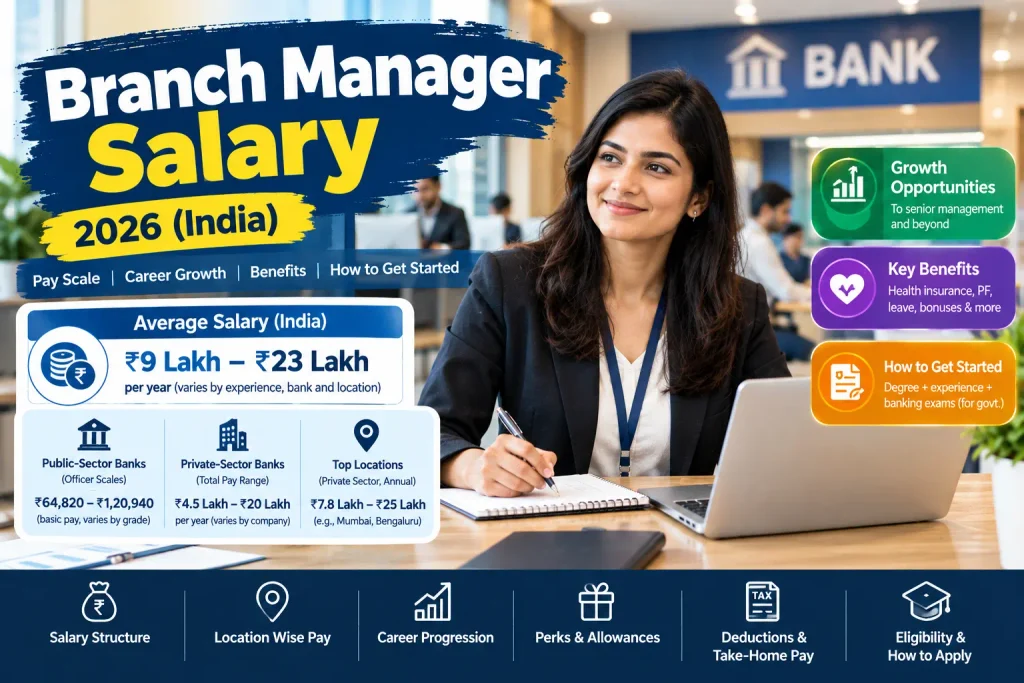
There is no single national pay figure because compensation depends heavily on the employer, officer scale, experience, city, and performance-linked components. For 2026, public-sector bank officers are governed by the revised banking wage structure, while private-sector figures are based mainly on employer and market salary data.
Who Is a Branch Manager?
A branch manager is responsible for the overall performance and administration of a financial-services branch. Typical duties include supervising staff, handling customer escalations, monitoring deposits and lending, ensuring regulatory compliance, reviewing branch profitability, and achieving business targets.
In banking, the position usually comes after experience as an officer, deputy manager, assistant manager, or relationship/operations professional. In some organizations, experienced candidates can also enter directly into management positions.
Public-Sector Bank Branch Manager Salary
Public-sector banks such as State Bank of India, Bank of India, Bank of Baroda, Punjab National Bank and other participating banks do not use the Central Government Pay Matrix for branch managers. Their officers follow the banking industry’s negotiated officer pay scales.
A branch manager can be positioned at different management scales depending on the bank, branch size, responsibilities, experience and promotion history. Scale II and Scale III are particularly relevant management grades, although the designation “Branch Manager” does not automatically guarantee one particular scale.
Public-Sector Salary Structure
The revised officer basic-pay scales under the 9th Joint Note are:
| Officer scale | Revised basic-pay structure | Maximum basic pay |
| MMGS-II | ₹64,820 + applicable increments | ₹93,960 |
| MMGS-III | ₹85,920 + applicable increments | ₹1,05,280 |
| SMGS-IV | ₹1,02,300 + applicable increments | ₹1,20,940 |
These are basic-pay scales, not take-home salaries or complete CTC figures. The published Bank of India pay structure and SBI officer documentation show the same revised Scale II and III ranges.
The salary package also includes allowances. For August–October 2026, the banking industry’s DA rate under the 12th Bipartite Settlement/9th Joint Note is 27.83% of pay, and it is periodically revised according to the CPI-based formula.
The 9th Joint Note also provides a 28.30% special allowance of basic pay for Scale II and III, with applicable DA on that allowance. HRA is generally 8%, 9% or 10% of pay depending on the posting area, while CCA can be ₹1,900 or ₹2,300 per month depending on location.
Indicative Public-Sector Monthly Gross
Using the published Scale II/III starting basic pay, August–October 2026 DA of 27.83%, Scale II/III special allowance, HRA and standard CCA, an illustrative monthly gross calculation is approximately:
| Grade | Starting basic | Illustrative monthly gross* |
| MMGS-II | ₹64,820 | About ₹1.15–₹1.16 lakh |
| MMGS-III | ₹85,920 | About ₹1.51–₹1.53 lakh |
*Illustrative calculation using the published allowance rates and a CCA-eligible posting. It is not a guaranteed branch-manager salary or take-home figure. Other allowances, bank-specific benefits, deductions and posting conditions can change the final amount.
This distinction matters: basic pay, gross salary, CTC and in-hand salary are different numbers.
Private-Sector Branch Manager Salary
Private banks do not follow the public-sector officer wage scale. Pay is determined by the employer, role size, branch business, experience, location and performance.
The latest large-sample AmbitionBox data available for India, updated in June 2025, places branch-manager compensation across industries at ₹2.8 lakh–₹18 lakh per year for roughly 4–17 years of experience. Within banking specifically, the reported range is ₹4.5 lakh–₹20 lakh per year for the same broad experience window.
Because the source does not publish a reliable nationwide median in the accessible data, it would be misleading to invent one.
| Private-sector benchmark | Annual pay |
| Banking-sector reported lower range | ₹4.5 lakh |
| Broad banking-sector reported range | ₹4.5–₹20 lakh |
| All-industry branch-manager range | ₹2.8–₹18 lakh |
These are reported salary ranges, not guaranteed 2026 offers. Senior managers at larger banks can fall above the broad range, while smaller financial companies may pay less.
For example, AmbitionBox reports ₹12.9 –₹22.2 lakh for Kotak Mahindra Bank branch managers in Bengaluru and ₹7.8 –₹25 lakh for IndusInd Bank branch managers in Mumbai, showing how employer and location can materially change compensation.
How Location Changes the Pay
Location affects both salary and living costs. Large financial centres such as Mumbai and Bengaluru can offer higher packages, but the higher nominal salary may also come with higher housing and commuting costs.
| Location example | Reported branch-manager range | Source context |
| Bengaluru — Canara Bank | ₹8–₹18 lakh | 6–15 years’ experience |
| Mumbai — IndusInd Bank | ₹7.8–₹25 lakh | 7–20 years’ experience |
| New Delhi — PNB | ₹12–₹22 lakh | 6–10 years’ experience |
The PNB Delhi sample is small, so it should be treated cautiously rather than as a citywide benchmark.
For public-sector banks, location also changes HRA and CCA. The revised banking settlement sets HRA at 10% in major “A” class cities, 9% in certain other areas and 8% in other locations, subject to the settlement’s rules.
Public vs Private Banking: Pay Structure Compared
| Factor | Public-sector bank | Private-sector bank |
| Main pay system | Industry officer wage settlement | Employer-specific |
| Common management scales | MMGS-II/III and above | Employer-specific grades |
| Basic-pay structure | Published scale | Usually confidential/employer-defined |
| DA | CPI-linked and periodically revised | Usually not structured like PSU bank DA |
| HRA/CCA | Settlement-based | Employer-specific |
| Performance pay | Bank/role dependent | Often more significant |
| Retirement benefits | PF/NPS/pension arrangements depending on eligibility | Usually PF plus employer-specific retirement benefits |
| Salary variation | Scale, seniority and posting | Employer, performance, city and experience |
The public-sector structure is more standardized. Private-sector compensation can vary much more between banks and financial-services companies.
Career Progression for a Branch Manager
There is no universal promotion timetable because banks have different internal policies. A common banking progression can look like:
Probationary Officer/Officer → Assistant Manager → Deputy Manager → Branch Manager → Senior/Chief Manager → Regional or Cluster-level role
Public-sector banking offers structured officer grades. For example, the current banking framework includes Scale I through Scale VII, with Scale II and III forming part of middle management and Scale IV/V forming senior management.
SBI’s own career material describes structured movement through officer grades and emphasizes promotion opportunities within the bank.
In private banks, a branch manager may progress toward senior branch manager, cluster branch manager, area manager, regional manager or business-head positions. The exact route depends on performance and vacancies.
Benefits and Perks
Public-sector bank employment can include benefits beyond basic salary. The 9th Joint Note covers allowances such as HRA, CCA, location allowance, learning allowance and special allowance.
SBI also lists medical benefits, accommodation or leased housing facilities for officers, concessional employee loans, leave benefits and travel-related benefits.
For SBI employees joining on or after August 1, 2010, the bank states that NPS applies, with employee contribution of 10% of basic pay plus DA and bank contribution of 14% of basic pay plus DA.
Private banks may provide health insurance, bonuses, incentives, retirement contributions, leave benefits and other perks, but these vary by employer and should be checked against the actual offer letter.
Deductions and Take-Home Pay
Do not treat annual CTC as monthly cash in hand. Common deductions can include income tax, employee retirement contributions, professional tax where applicable, insurance and other employer-specific deductions.
For AY 2026–27, the new income-tax regime has slabs beginning with no tax up to ₹4 lakh, followed by 5%, 10%, 15%, 20%, 25% and 30% bands as taxable income rises. A resident individual can also qualify for the enhanced Section 87A rebate subject to the stated conditions.
The actual tax depends on taxable income, deductions, exemptions and the tax regime selected. State-specific professional tax and other deductions can also affect the amount reaching your bank account.
For public-sector employees, retirement contributions can also reduce monthly cash pay. SBI, for example, documents NPS contributions for employees covered by its post-2010 arrangement.
How to Become a Branch Manager
A common public-sector route is to enter banking as a probationary officer or another officer-level recruit and then progress through internal promotions.
IBPS’s 2026–27 calendar includes recruitment for Probationary Officers/Management Trainees in participating public-sector banks, with preliminary and main examinations scheduled as part of the recruitment process.
Another route is direct recruitment into experienced officer positions when a bank advertises them. Regional Rural Banks also separately recruit Officers in Scale I, II and III through IBPS processes.
For private banks, a bachelor’s degree in areas such as business, finance, economics or another relevant discipline can help, but employers generally place greater weight on banking experience, sales performance, customer management, credit knowledge, compliance and leadership ability for branch-management positions.
Useful skills include:
- Retail banking and lending knowledge
- Customer relationship management
- Sales and business development
- Credit and risk awareness
- RBI and KYC/AML compliance knowledge
- Team leadership
- Financial analysis
- Communication and negotiation
Is Being a Branch Manager a Good Career?
The role combines financial responsibility with people management. Public-sector banking offers a relatively standardized pay framework and established benefits, while private banking can provide more variation in compensation and faster movement between employers.
The trade-off is that branch managers often carry substantial sales, compliance and operational responsibility. Targets, customer escalations and staffing issues can make the job demanding, so the role suits people who are comfortable balancing business growth with regulatory and service responsibilities.
FAQs
What is the average branch manager salary in India?
There is no single reliable nationwide average. AmbitionBox’s 2025 dataset reports ₹2.8 –₹18 lakh across branch-manager roles and ₹4.5 –₹20 lakh specifically for banking, with substantial variation by experience and employer.
What is the starting basic pay for a public-sector bank manager?
A relevant revised management scale begins at ₹64,820 for MMGS-II and ₹85,920 for MMGS-III. These are basic-pay figures, not take-home salaries.
Does a branch manager get DA?
Officers covered by the banking industry’s current settlement receive DA linked to the CPI-based formula. For August–October 2026, the rate is 27.83% of pay under the 12th Bipartite Settlement/9th Joint Note.
Can a fresher become a branch manager directly?
Usually, branch management is an experienced position rather than a typical fresher appointment. A common route is to enter banking as an officer and progress through promotions, although some organizations recruit experienced managers directly.
Is private-bank compensation higher than public-sector bank pay?
The available salary data shows significant overlap rather than one universal pattern. Private-bank packages can vary widely by employer, while public-sector banks use more standardized officer scales and allowances.
What qualifications are useful for this career?
A bachelor’s degree is a common starting point for banking recruitment. For management-level positions, banking experience, leadership ability, lending knowledge, compliance skills and business-development performance become increasingly important.
Conclusion
A branch manager salary in India depends on the banking segment, officer grade, experience, location and employer. Public-sector banks provide a defined officer pay structure with periodically revised allowances, while private institutions offer employer-specific packages with wider variation. For anyone planning this career, comparing the complete package not just the advertised annual CTC is essential.