
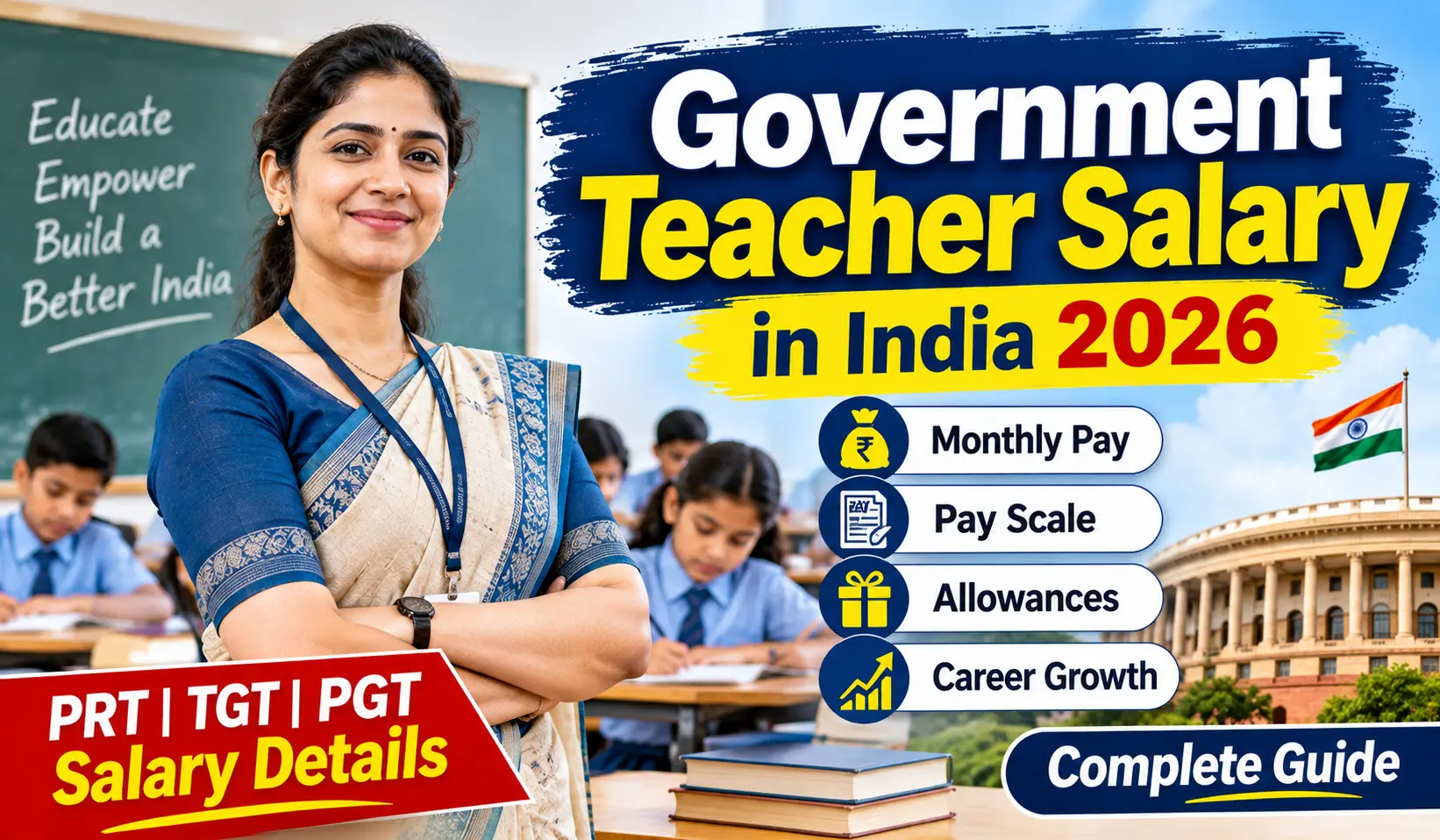
The government teacher salary in India in 2026 depends on the teaching position, recruiting department, state and experience. In Kendriya Vidyalaya Sangathan (KVS), the starting basic pay is ₹35,400 for Primary Teachers (PRT), ₹44,900 for Trained Graduate Teachers (TGT) and ₹47,600 for Post Graduate Teachers (PGT).
These figures represent entry-level basic pay under the applicable central pay matrix, not guaranteed monthly take-home salary. Teachers may receive additional allowances depending on their appointment and posting.
Government Teacher Salary: Quick Answer
A government school teacher’s starting salary varies according to the teaching level and employer.
For central government schools such as KVS, the published entry-level pay structure is:
- PRT: ₹35,400 basic pay per month.
- TGT: ₹44,900 basic pay per month.
- PGT: ₹47,600 basic pay per month.
These are official KVS pay-matrix entry figures. State government teachers may receive different basic pay according to their respective state pay rules.
Source: KVS Recruitment Rules and the 7th Central Pay Commission pay matrix. Figures are basic pay, not gross or in-hand salary.
Government Teacher Salary 2026: Main Salary Table
The following table compares the entry-level salary structure for regular teaching positions in Kendriya Vidyalayas.
| Teaching position | Pay level | Starting basic salary | Approx. monthly equivalent of basic pay |
| Primary Teacher (PRT) | Level 6 | ₹35,400 | ₹35,400 |
| Trained Graduate Teacher (TGT) | Level 7 | ₹44,900 | ₹44,900 |
| Post Graduate Teacher (PGT) | Level 8 | ₹47,600 | ₹47,600 |
Source: KVS recruitment rules. Monthly equivalent is the monthly basic-pay amount, not take-home pay. Annual basic-pay equivalents are ₹4,24,800, ₹5,38,800 and ₹5,71,200 respectively, before allowances and deductions.
Important: The pay matrix also provides senior and selection scales for eligible teachers. These are progression stages subject to applicable service rules, not automatic starting salaries for every new recruit.
Salary Tables and Detailed Breakdown
Government Teacher Salary Per Month
Monthly government teacher compensation generally consists of basic pay and admissible allowances.
A regular central government school teacher’s gross salary may include:
- Basic pay according to the applicable pay level.
- Dearness Allowance (DA).
- House Rent Allowance (HRA), where admissible.
- Transport Allowance (TA), where applicable.
- Other admissible benefits under service rules.
The gross salary is calculated before deductions. The final in-hand amount is lower after applicable retirement contributions, insurance and taxes.
For example, a newly appointed KVS PRT starts with basic pay of ₹35,400. This is only the fixed basic component; allowances are calculated separately.
Government Teacher Salary for Freshers
Freshers who successfully qualify for a regular government teaching appointment generally start at the entry cell of the applicable pay level.
| Position | Starting basic pay | Recruitment level |
| PRT | ₹35,400 | Level 6 |
| TGT | ₹44,900 | Level 7 |
| PGT | ₹47,600 | Level 8 |
These figures apply to the cited KVS pay structure. They should not be used as universal starting salaries for all state government schools.
What about contractual teachers?
Contractual appointments are different from regular government service.
KVS publishes separate consolidated monthly payments for contractual teachers. Its contractual-teacher information lists:
| Contractual position | Normal station | Hard station |
| PRT | ₹21,250 | ₹26,250 |
| TGT | ₹26,250 | ₹31,250 |
| PGT | ₹27,500 | ₹32,500 |
Source: KVS contractual teacher payment information. These are consolidated monthly payments, not regular pay-matrix salaries. Confirm the latest applicable school-year engagement notice before relying on them.
A contractual teacher does not automatically receive the same benefits and service conditions as a regular permanent employee.
Government Teacher Salary by Experience
Experience affects salary through annual increments, financial progression and promotion.
The central pay matrix provides defined salary cells within each level.
| Career stage | Salary determination |
| Newly appointed | Entry basic pay for the post |
| Junior teacher | Entry level plus applicable increments |
| Experienced teacher | Higher pay-matrix cell based on service |
| Senior-scale teacher | Applicable senior-scale rules |
| Selection-scale teacher | Applicable selection-scale rules |
| Principal or senior administrator | Separate higher-level pay structure |
For KVS, published recruitment rules provide the following progression structures:
- PRT: Level 6 entry, Level 7 senior and Level 8 selection scale.
- TGT: Level 7 entry, Level 8 senior and Level 10 selection scale.
- PGT: Level 8 entry, Level 10 senior and Level 11 selection scale.
These are formal pay progression scales. Movement between them is governed by eligibility, service requirements and the applicable rules.
Government Teacher In-Hand Salary
The in-hand salary is the amount deposited into a teacher’s bank account after applicable deductions.
It is not necessarily equal to the basic salary or gross salary.
Common deductions include:
- National Pension System (NPS) contributions, where applicable.
- Income tax under the selected tax regime.
- Insurance or group insurance contributions.
- Other authorised deductions.
- Any applicable professional tax under the relevant state rules.
The final amount also depends on allowances, posting location and employment conditions.
Therefore, it would be misleading to publish one fixed in-hand salary for every government teacher.
Central Government Teacher Salary
Central government school teachers work in institutions administered by the Union Government or its organisations.
Important employers include:
- Kendriya Vidyalaya Sangathan (KVS)
- Navodaya Vidyalaya Samiti (NVS)
- Central schools and other eligible government educational institutions.
Their salary structures depend on the relevant recruitment rules and service conditions.
KVS Teacher Salary
KVS provides a clearly documented example of the central government teacher pay structure.
| Post | Entry pay level | Basic pay range |
| PRT | Level 6 | ₹35,400–₹1,12,400 |
| TGT | Level 7 | ₹44,900–₹1,42,400 |
| PGT | Level 8 | ₹47,600–₹1,51,100 |
KVS also provides higher senior and selection scales for eligible teachers.
The revised KVS recruitment rules dated 22 January 2026 document these pay levels.
NVS Teacher Salary
The Navodaya Vidyalaya Samiti recruits teachers for Jawahar Navodaya Vidyalayas.
NVS teaching positions include:
- Post Graduate Teachers.
- Trained Graduate Teachers.
- Other teaching and specialist positions.
The salary should be checked against the specific NVS recruitment notification. Do not automatically apply every KVS recruitment condition or allowance to an NVS employee.
For accurate information, candidates should consult the official NVS website and the relevant recruitment advertisement.
State Government Teacher Salary
State government teacher salaries are determined by individual state governments and their education departments.
The central government does not establish one identical salary structure for all state teachers. Recruitment, service conditions and salary structures are governed by the respective state or Union Territory authorities.
The salary may depend on:
- State pay commission recommendations.
- Applicable state pay matrix.
- Primary, secondary or senior-secondary teaching position.
- Appointment category.
- Permanent or contractual employment.
- Posting location.
- DA and HRA policies.
Government Teacher Salary by State
| State | Recruiting authority | Salary information |
| Uttar Pradesh | UPPSC / UP education authorities, depending on post | State-specific pay rules |
| Bihar | BPSC / Bihar education authorities | State-specific pay rules |
| Rajasthan | RPSC / Rajasthan education authorities | State-specific pay rules |
| Maharashtra | Maharashtra education authorities | State-specific pay rules |
| Madhya Pradesh | MPESB / relevant education authorities | State-specific pay rules |
| Haryana | Haryana education authorities | State-specific pay rules |
| West Bengal | WBSSC / relevant education authorities | State-specific pay rules |
| Punjab | Punjab education authorities | State-specific pay rules |
This table identifies relevant recruitment jurisdictions, not a verified salary ranking. A state-specific salary figure should be taken from the latest applicable recruitment advertisement or pay order.
Why do salaries differ between states?
Some states use pay structures based on their own pay commission decisions, while others revise central pay recommendations with modifications. Allowances and contractual employment policies can also differ.
KVS vs State Government Teacher Salary
Both central and state government teachers work in public education, but their compensation systems are not identical.
| Comparison | KVS teacher | State government teacher |
| Employer | Central government organisation | State education department or authority |
| Pay structure | KVS recruitment rules and applicable central pay matrix | State-specific pay structure |
| DA | Applicable central rules | Applicable state rules |
| HRA | Central rules and posting conditions | State rules and posting conditions |
| Recruitment | KVS recruitment process | State recruitment process |
| Transfers | Subject to KVS service rules | Subject to state service rules |
A candidate should compare the actual advertised pay level, appointment terms and location rather than assuming that every central school offers higher compensation.
Factors That Affect Government Teacher Salary
Several factors influence how much a teacher receives during their career.
1. Teaching Level
PRT, TGT and PGT positions have different educational requirements and pay levels in KVS.
2. Experience
Annual increments and eligible career progression increase basic pay over time.
3. Education and Qualifications
A relevant degree, professional teaching qualification and subject specialisation determine eligibility for different posts.
4. Employer
KVS, NVS and state education departments have different recruitment and service frameworks.
5. Posting Location
The applicable HRA and certain other allowances may depend on the city classification and posting.
6. Employment Type
Regular, contractual, temporary and guest-teacher appointments have different compensation arrangements.
7. Promotion
Moving to a higher teaching or administrative position can change the applicable pay level.
8. Government Pay Revisions
Changes to government pay policies and allowance rates can affect compensation.
The Eighth Central Pay Commission was constituted in November 2025. Its recommendations should not be treated as an implemented teacher salary revision without an official approval and implementation order.
What Does a Government Teacher Do?
A government school teacher is responsible for educating students according to the prescribed curriculum and academic standards.
Daily responsibilities generally include:
- Preparing lesson plans.
- Teaching assigned subjects.
- Conducting classroom activities.
- Evaluating assignments and examinations.
- Maintaining student attendance and academic records.
- Supporting students who need additional guidance.
- Participating in school meetings.
- Communicating with parents.
- Supporting educational and extracurricular activities.
Senior teachers may also assist with academic coordination, mentoring new teachers and administrative responsibilities.
Difference Between PRT, TGT and PGT
PRT – Primary Teacher
Teaches primary-level students, generally in the early school grades. Focuses on foundational literacy, numeracy and basic learning.
Government School Teachers in Manipur are likely to have ‘Uniform’ Soon
TGT – Trained Graduate Teacher
Teaches subject-specific lessons at the middle and secondary school levels, according to the school’s classes and recruitment rules.
PGT – Post Graduate Teacher
Teaches specialised subjects at the senior-secondary level and generally requires a relevant postgraduate qualification.
Government Teacher Qualification and Eligibility
The educational requirements depend on the post, teaching level and recruiting authority.
The NCTE establishes minimum qualification regulations for school teachers. Recruitment authorities apply the relevant requirements through their advertisements and service rules.
PRT Qualification
For the regular KVS Primary Teacher post, the published recruitment rules include these qualification routes:
- Class 12 with at least 50% marks and a two-year Diploma in Elementary Education.
- Class 12 with at least 50% marks and a four-year B.El.Ed.
- Relevant recognised special-education qualification where permitted.
- CTET Paper I qualification.
The exact subject, percentage and professional qualification conditions must be checked in the relevant advertisement.
TGT Qualification
KVS TGT recruitment rules generally require:
- A recognised bachelor’s degree with the prescribed subject combination and marks.
- A recognised B.Ed. or another permitted integrated teacher-education qualification.
- CTET Paper II qualification.
- Subject-specific eligibility.
For example, a mathematics TGT applicant must meet the prescribed mathematics and other subject-combination requirements.
PGT Qualification
For KVS PGT positions, applicants generally need:
- A relevant master’s degree with the prescribed minimum marks.
- A recognised B.Ed. or an accepted integrated qualification, where required.
- The required subject background at graduation level.
- Other conditions specified in the recruitment rules.
The exact requirements differ by subject. Some positions have special provisions.
Age Limit
Age limits are not identical across all teaching positions.
For example, the cited KVS recruitment rules specify direct-recruitment upper age limits of:
- PRT: 30 years.
- TGT: 35 years.
- PGT: 40 years.
Applicable age relaxations depend on category and government rules. These are KVS-specific figures, not universal limits for every state recruitment examination.
CTET and State TET Requirements
Teacher Eligibility Tests are important for candidates seeking elementary and other eligible teaching positions.
There are two commonly encountered examinations:
CTET: Conducted by CBSE for eligible central-level and other specified teaching recruitments.
State TET: Conducted by the respective state authority for teaching eligibility under applicable state recruitment rules.
The two CTET papers cover different teaching stages:
- Paper I: Classes I to V.
- Paper II: Classes VI to VIII.
Qualifying CTET does not automatically guarantee a government teaching job. Candidates must also meet the academic, professional, age and selection requirements of the employer.
The official CTET information bulletin provides examination and eligibility details.
How to Become a Government Teacher in India
Follow these steps to prepare for a government teaching career.
- Complete school education: Obtain the required Class 12 or equivalent qualification.
- Choose your teaching level: Decide whether you want to become a PRT, TGT or PGT.
- Complete the relevant degree: Pursue D.El.Ed., B.El.Ed., graduation, postgraduate education or B.Ed., as required.
- Qualify the eligibility examination: Pass CTET or the relevant State TET where required.
- Check recruitment notifications: Follow KVS, NVS, state PSC and education department announcements.
- Apply for vacancies: Submit the application and supporting educational documents.
- Clear the selection process: Complete the written examination, interview or other prescribed stages.
- Complete verification: Pass document verification and any required medical or other formalities.
- Join the institution: Complete appointment formalities and any applicable probation.
For current examination requirements, candidates should consult official recruitment notices rather than relying on older eligibility summaries.
Government Teacher Career Growth
Government teachers can progress through academic and administrative roles.
A typical career structure may look like:
Primary / Graduate / Postgraduate Teacher
Entry teaching appointment
Senior-scale teacher
Eligible pay progression
Selection-scale teacher
Subject to applicable service rules
Headmaster / Vice Principal / Principal
Separate eligibility and selection requirements
Not every teacher follows the same promotion route. Some progress through financial upgradation, while others move into higher teaching or administrative positions.
KVS recruitment rules also describe departmental progression routes, including promotion from eligible PRT positions to TGT and from TGT to PGT where applicable.
Government Teacher Salary, Benefits and Allowances
Regular government teachers may receive several benefits in addition to basic pay.
Dearness Allowance (DA)
DA is intended to help employees manage changes in the cost of living. Central government DA rates are revised through official government orders.
For 2026, the Department of Expenditure published a DA revision order effective from 1 July 2026. The applicable rate should be taken from the latest official order rather than an outdated salary calculator.
House Rent Allowance (HRA)
HRA may be paid according to the applicable city classification and service rules. Eligibility and rates can vary by employer and accommodation arrangements.
Transport Allowance
Eligible employees may receive transport allowance under the relevant government rules.
Medical Benefits
Regular employees may have access to medical facilities or reimbursement according to the applicable employment framework.
Retirement Benefits
Retirement benefits depend on the applicable pension and service rules. Many newly recruited central government employees are covered by the National Pension System, subject to applicable rules and options.
Leave Benefits
Eligible regular employees may receive:
- Earned leave.
- Casual leave.
- Medical leave or other applicable leave.
- Maternity or paternity leave under relevant rules.
- Other approved service-related leave.
Contractual teachers may have significantly different leave entitlements.
Government Teacher Salary After Tax and Deductions
The amount received in a bank account depends on salary components and deductions.
The main factors include:
- Total annual taxable income.
- Applicable income-tax regime.
- Eligible tax deductions and exemptions.
- NPS or other applicable retirement contributions.
- Insurance and group scheme deductions.
- Professional tax where applicable.
- Other authorised deductions.
A teacher should use the actual salary slip and current tax rules to calculate take-home pay.
Do not calculate tax only on basic salary because taxable income may also include allowances and other components.
PRT vs TGT vs PGT: Salary and Career Comparison
Candidates often compare these three teaching positions before choosing a degree or professional qualification.
| Comparison | PRT | TGT | PGT |
| Full form | Primary Teacher | Trained Graduate Teacher | Post Graduate Teacher |
| Teaching level | Primary | Middle/secondary | Senior secondary |
| Typical qualification | Class 12 + elementary teaching qualification | Graduation + B.Ed. or accepted equivalent | Relevant master’s degree + required teaching qualification |
| KVS entry pay level | 6 | 7 | 8 |
| KVS starting basic pay | ₹35,400 | ₹44,900 | ₹47,600 |
| CTET paper | Paper I | Paper II | Depends on recruitment rules |
| Subject specialisation | Foundational education | Subject-specific | Advanced subject-specific |
Which teaching position should you choose?
- Choose PRT if you want to teach younger students and meet the elementary teaching requirements.
- Choose TGT if you have a relevant graduation degree and want to teach middle or secondary classes.
- Choose PGT if you have a relevant postgraduate qualification and want to teach senior-secondary students.
The appropriate position depends on your educational qualifications, subject interests and career goals.
Frequently Asked Questions About Government Teacher Salary
1. What is the government teacher salary per month in India in 2026?
For regular KVS teachers, starting basic pay is ₹35,400 for PRT, ₹44,900 for TGT and ₹47,600 for PGT. Gross and in-hand salaries are higher or lower depending on allowances and deductions.
2. What is the starting salary of a government teacher?
The starting basic salary depends on the employer and teaching position. Under the cited KVS pay structure, it starts at ₹35,400 for PRT, ₹44,900 for TGT and ₹47,600 for PGT.
3. What is the government PRT teacher salary?
A regular KVS PRT starts at Level 6 with basic pay of ₹35,400 per month. The pay matrix extends to ₹1,12,400, with separate senior and selection scales.
4. What is the government TGT teacher salary?
A KVS TGT starts at Level 7 with basic pay of ₹44,900 per month. Its entry-scale pay range is ₹44,900–₹1,42,400.
5. What is the government PGT teacher salary?
A KVS PGT starts at Level 8 with basic pay of ₹47,600 per month. The entry-scale pay range is ₹47,600–₹1,51,100.
6. What is the in-hand salary of a government teacher?
The in-hand salary depends on basic pay, DA, HRA, transport allowance, retirement contributions, taxes and other deductions. There is no single take-home amount for all teachers.
7. Do government teachers receive DA and HRA?
Eligible regular teachers may receive DA and HRA according to their employer’s applicable service rules. Rates depend on the relevant government orders and posting location.
8. Is the government teacher salary the same in every state?
No. State governments follow their own salary structures, allowances and recruitment rules. Central government school teachers follow the relevant central organisation’s pay framework.
9. What qualification is required to become a government teacher?
PRT candidates generally need an elementary teaching qualification, while TGT applicants generally need graduation and a recognised teaching qualification. PGT candidates generally need a relevant master’s degree and the required professional qualification.
10. Is CTET compulsory for all government teacher jobs?
No. CTET is required for positions where the applicable recruitment rules prescribe it. State-level appointments may require a State TET or another eligibility examination.
11. Do contractual government teachers receive the same salary as permanent teachers?
No. Contractual teachers may receive consolidated monthly payments rather than regular pay-matrix salaries. Their benefits, leave and employment conditions can also differ.
12. Will the 8th Pay Commission increase government teacher salaries?
The Eighth Central Pay Commission has been constituted, but its recommendations and their implementation must be distinguished. Candidates should not rely on speculative revised salary figures until the government issues official decisions.
Conclusion
The government teacher salary in India in 2026 depends mainly on teaching level, employer, state pay rules and experience. KVS provides a useful central-government benchmark, with starting basic pay of ₹35,400 for PRT, ₹44,900 for TGT and ₹47,600 for PGT.
Along with salary, candidates should consider professional qualifications, CTET or State TET requirements, promotion opportunities and employment benefits.
If you are planning to enter the teaching profession, check the latest recruitment notification before applying. It is the most reliable way to confirm the actual pay scale, eligibility and appointment conditions.