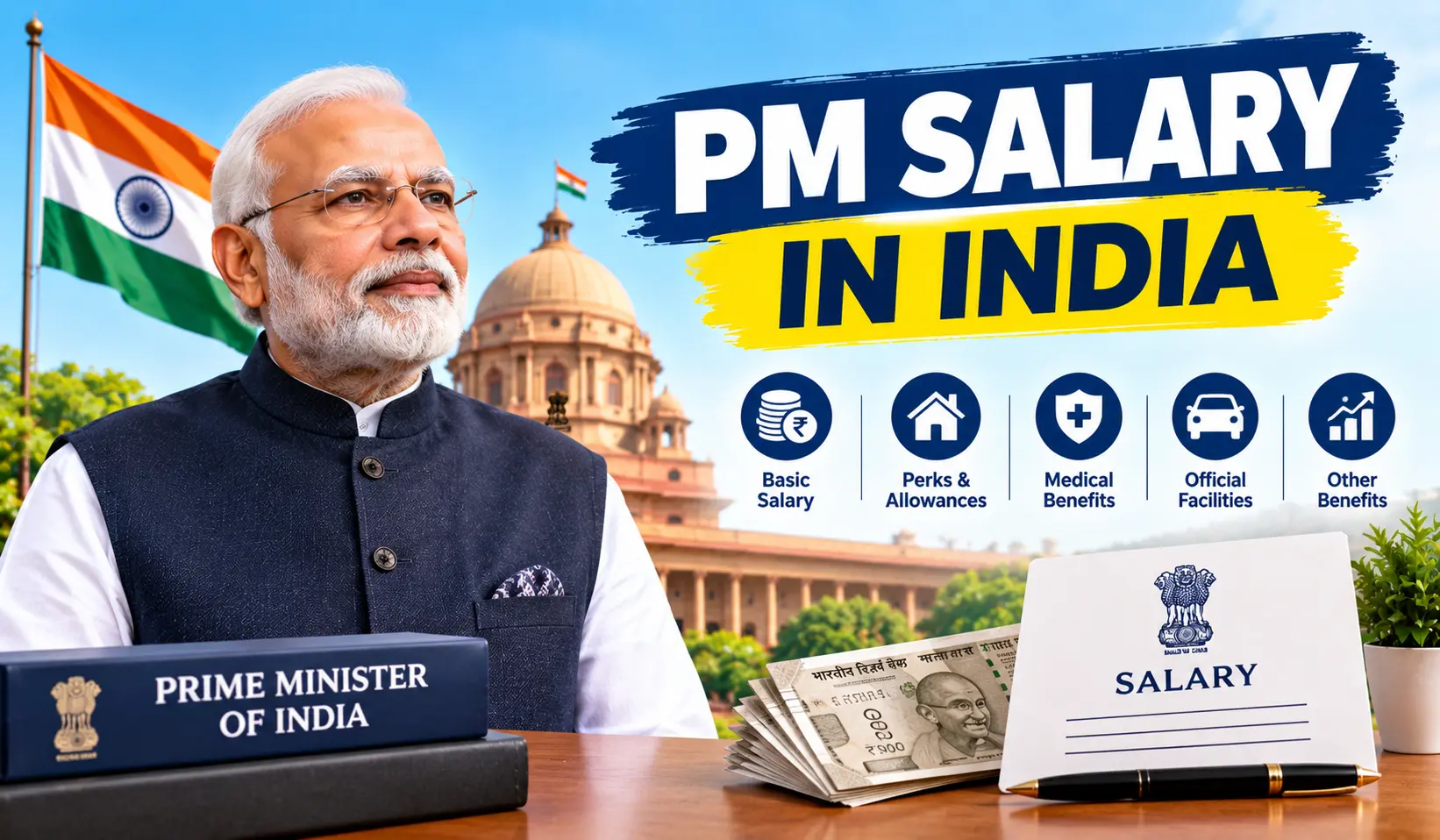
The Prime Minister (PM) of India is the head of the Union Government and the most senior elected executive office-holder in the country. Unlike most careers covered in salary guides, this position exists only within the Government of India and does not have a private-sector equivalent.
People often search for the Prime Minister’s earnings out of curiosity, but understanding the compensation package requires looking beyond the monthly salary. The role includes official allowances, government-provided facilities, security arrangements, official residences, and other benefits governed by law.
This guide explains the PM salary in India structure, allowances, career path, deductions, and how the position fits into India’s constitutional framework.
Who Is the Prime Minister of India?
The Prime Minister is the leader of the Union Council of Ministers and the head of the executive branch of the Government of India.
Key responsibilities include:
- Leading the Union Government
- Chairing Cabinet meetings
- Advising the President on ministerial appointments
- Coordinating national policy
- Representing India internationally
- Supervising major government initiatives
- Managing inter-ministerial decision-making
The position is established under the Constitution of India and is typically held by the leader of the majority party or coalition in the Lok Sabha.
Government Sector Salary Structure
The Prime Minister is covered under The Salaries and Allowances of Ministers Act, 1952, which governs the pay and allowances of ministers, including the Prime Minister. The Prime Minister’s Office states that pay and allowances are provided according to this legislation.
Unlike civil servants such as IAS officers, the Prime Minister is not paid under the Central Pay Commission pay matrix.
Prime Minister Compensation Structure (2026)
| Component | Status | Source |
| Parliamentary Salary | Payable under applicable MP salary provisions | Parliament/Ministerial salary laws |
| Ministerial Salary & Allowances | Payable under Salaries and Allowances of Ministers Act | Government rules |
| Official Residence | Provided | Government entitlement |
| Official Transport | Provided | Government entitlement |
| Security Cover | Provided | Government entitlement |
| Domestic and International Official Travel | Provided for official duties | Government entitlement |
| Staff and Administrative Support | Provided | Government entitlement |
The exact cash compensation received can change because some elements are revised through legislation or inflation-linked adjustments. Parliament revised MP salary-related provisions with effect from April 2023 based on the Cost Inflation Index. The revised MP salary became ₹1,24,000 per month, with corresponding revisions to certain allowances.
Salary Components Linked to Parliamentary Entitlements
| Component | Revised Rate (effective from April 2023) |
| Salary | ₹1,24,000 per month |
| Daily Allowance | ₹2,500 per day (when applicable under rules) |
| Constituency Allowance | ₹87,000 per month |
| Office Expense Allowance | ₹75,000 per month |
Source: Government notification on revision of MPs’ salaries and allowances.
Important note: The Prime Minister’s total compensation package is not simply the sum of MP salary components. Ministerial allowances, official facilities, and benefits are governed by separate provisions. The PMO confirms that the Prime Minister’s pay and allowances are regulated under the Salaries and Allowances of Ministers Act.
Pay Variation by Location
Unlike most professions, the Prime Minister’s compensation does not vary based on city, state, or posting location.
Location-Based Comparison
| Factor | Impact |
| State Posting | Not applicable |
| Metro City Adjustment | Not applicable |
| HRA Variation | Not applicable |
| Cost-of-Living Allowance by Region | Not applicable |
| Official Residence | Provided in New Delhi |
The office is based in New Delhi, and official accommodation is provided as part of the position.
Comparison With Other Senior Government Positions
Since this role exists only in government, comparing it with other constitutional and senior public offices is more useful than comparing sectors.
| Position | Compensation Basis |
| Prime Minister | Ministerial and parliamentary salary framework |
| Cabinet Minister | Salaries and Allowances of Ministers Act |
| Minister of State | Salaries and Allowances of Ministers Act |
| Member of Parliament | Salary and allowances under MP provisions |
| Cabinet Secretary | Level 18 pay matrix under 7th CPC |
| Chief Secretary (State) | Senior IAS pay levels |
Each position is governed by a different legal and administrative framework.
Career Progression and Advancement Path
The Prime Minister is not recruited through an examination or standard employment process.
Typical Political Career Path
| Stage | Common Route |
| Political Party Worker | Entry into political activity |
| Local Government Representative | Panchayat, municipal, or local body roles |
| State Legislator | MLA or equivalent |
| Member of Parliament | Election to Lok Sabha or Rajya Sabha |
| Minister | Appointment to Union Council of Ministers |
| Prime Minister | Leader commanding majority support in Lok Sabha |
There is no guaranteed timeline. Some politicians spend decades in public life before reaching senior national positions, while others rise more quickly depending on electoral success and political circumstances.
Benefits and Perks
The compensation package includes numerous official facilities necessary for carrying out constitutional responsibilities.
Official Benefits
- Official residence in New Delhi
- Official staff support
- Security arrangements
- Official transportation
- Domestic and international travel for official duties
- Administrative infrastructure
- Communication and office support
These facilities are attached to the office rather than being personal employment benefits.
Employment Stability
The Prime Minister does not have a fixed employment contract. The office is held as long as the individual retains the confidence of the Lok Sabha majority under India’s parliamentary system.
Deductions and Take-Home Considerations
Like other public office holders, the Prime Minister is subject to applicable Indian tax laws.
Income Tax
Income is taxable under the Income-tax Act unless specifically exempted by law.
The actual tax liability depends on:
- Applicable salary components
- Tax regime selection where relevant
- Allowances and exemptions
- Legislative provisions in force during the financial year
Other Considerations
| Item | Applicability |
| Income Tax | Yes |
| Surcharge/Cess | As applicable under tax law |
| Pension Contributions | Governed by applicable rules |
| Official Benefits | Some are non-cash facilities |
Because tax laws and salary-related legislation can change, net take-home earnings may differ from gross compensation.
How to Become Prime Minister of India
There is no direct recruitment process.
Basic Constitutional Requirements
A Prime Minister must:
- Be an Indian citizen
- Be eligible to become a Member of Parliament
- Command the confidence of the Lok Sabha majority
Typical Route
- Enter politics through a political party
- Build electoral support
- Contest elections
- Become a Member of Parliament
- Gain leadership within a political party or coalition
- Be invited by the President to form the government after demonstrating majority support
This process is political rather than administrative or examination-based.
Should You Pursue This Career Path?
The position offers unmatched influence over public policy and national governance. However, it is not a traditional career choice in the way that civil services, law, medicine, or engineering are.
The workload is exceptionally demanding. Public scrutiny is constant, and success depends on electoral outcomes, political leadership, coalition management, and public support.
Financial compensation is only one small part of the role. Most people who reach this office spend many years in politics before becoming eligible for national leadership.
Frequently Asked Questions
1. What is the PM salary in India in 2026?
The Prime Minister receives pay and allowances under the Salaries and Allowances of Ministers Act, while parliamentary salary-related provisions were revised to ₹1,24,000 per month for MPs from April 2023 under inflation-linked revisions.
2. Is the Prime Minister paid under the 7th Pay Commission?
No. The Prime Minister is not paid under the Central Pay Commission pay matrix used for civil servants such as IAS officers. The office is governed by separate legislation.
3. Does the Prime Minister receive government accommodation?
Yes. Official residential facilities are provided as part of the office’s constitutional and administrative requirements.
4. Can a Prime Minister receive allowances in addition to salary?
Yes. Compensation includes allowances and official facilities provided under applicable laws and government rules.
5. Is there an age limit for becoming Prime Minister?
The Constitution does not specify a separate age limit for the office itself, but the individual must meet the eligibility requirements applicable to Members of Parliament.
6. Does the Prime Minister pay income tax?
Yes. Income is subject to applicable tax laws unless specifically exempt under legislation.
Conclusion
The PM salary in India differs significantly from standard government jobs because it is governed by ministerial and parliamentary legislation rather than civil-service pay scales. While the office includes salary, allowances, and official facilities, its significance lies more in national leadership responsibilities than in financial compensation. Anyone interested in this path should focus on public service, political leadership, and electoral success rather than earnings alone.