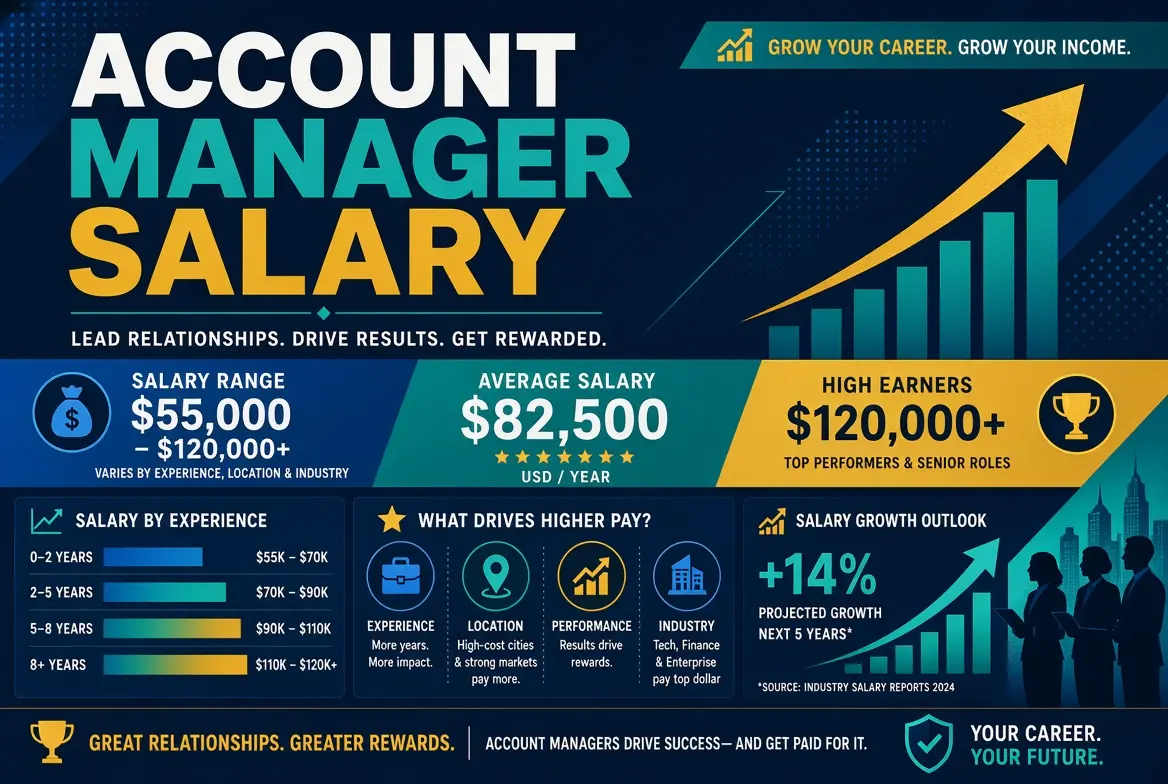
Account Managers play a critical role in helping companies retain clients, grow revenue, and maintain long-term business relationships. They act as the bridge between customers and the organization, ensuring that client needs are met while identifying opportunities for additional business.
In India, this position is found primarily in the private sector, especially in IT services, SaaS, advertising, digital marketing, banking, telecom, manufacturing, consulting, and enterprise sales organizations.
While some public-sector enterprises may employ relationship or client-management professionals, the Account Manager role is overwhelmingly a private-sector position with market-driven compensation rather than government pay scales.
This guide explains how much Account Managers earn in India in 2026, how salaries vary by experience and location, career progression opportunities, benefits, deductions, and how to enter the profession.
Who Is an Account Manager?
An Account Manager is responsible for managing relationships with existing clients after a sale has been completed. The role focuses on client satisfaction, retention, contract renewals, upselling, cross-selling, and resolving business issues.
Typical responsibilities include:
- Managing key customer accounts
- Conducting client meetings and reviews
- Coordinating with internal teams
- Identifying growth opportunities
- Negotiating renewals and contracts
- Monitoring customer satisfaction metrics
- Supporting revenue retention targets
Account Managers are commonly employed in:
- IT services and software companies
- Digital marketing agencies
- Advertising firms
- Telecom companies
- Banking and financial services
- Manufacturing and B2B organizations
- SaaS and technology startups
Private Sector Salary Structure
Since Account Manager is primarily a private-sector role in India, compensation varies significantly by industry, employer size, location, and performance.
Account Manager Salary Structure (India 2026)
| Pay Component | Typical Range |
| Base Salary | ₹5 lakh – ₹12 lakh per year |
| Average Base Salary | Around ₹7 lakh – ₹8 lakh per year |
| Variable Pay / Performance Bonus | ₹45,000 – ₹4 lakh per year |
| Total Compensation | ₹5.8 lakh – ₹17 lakh+ per year |
| Monthly Gross Salary | Approximately ₹42,000 – ₹1,00,000+ |
| Senior-Level Compensation | ₹12 lakh – ₹25 lakh+ per year |
Sources: Glassdoor India reports average Account Manager base salaries around ₹7–8 lakh annually, with additional compensation ranging from approximately ₹45,000 to ₹4 lakh depending on employer and performance.
Typical Compensation Breakdown
| Component | Common Structure |
| Fixed Salary | 70%–90% of total package |
| Performance Bonus | 5%–20% |
| Sales Incentives (where applicable) | Variable |
| Retention Bonus | Employer-specific |
| Health Insurance | Usually included |
| Provident Fund Contribution | Standard for eligible employees |
Many technology and SaaS companies place a larger portion of compensation in performance-linked incentives than traditional industries.
Pay Variation by Location
Location remains one of the biggest factors affecting earnings.
City-Wise Salary Comparison
| City | Typical Annual Salary Range |
| Bengaluru | ₹7 lakh – ₹15 lakh |
| Mumbai | ₹6.5 lakh – ₹14 lakh |
| Hyderabad | ₹6 lakh – ₹13 lakh |
| Delhi NCR | ₹6 lakh – ₹13 lakh |
| Pune | ₹6 lakh – ₹12 lakh |
| Chennai | ₹5.5 lakh – ₹11 lakh |
| Ahmedabad | ₹5 lakh – ₹10 lakh |
| Tier-2 Cities | ₹4 lakh – ₹9 lakh |
Source Basis: Salary aggregators and employer-reported compensation data indicate that Bengaluru, Mumbai, and major technology hubs generally offer the highest compensation due to concentration of enterprise sales, SaaS, consulting, and IT services employers.
Remote vs On-Site Roles
| Work Arrangement | Impact on Compensation |
| Fully On-Site | Standard market rates |
| Hybrid | Similar to on-site |
| Remote (India-wide hiring) | Often location-neutral at larger firms |
| International Client Accounts | Frequently higher-paying |
Organizations serving overseas clients often pay more because of larger contract values and greater revenue responsibility.
Salary Comparison by Experience Level
Since this role primarily exists in the private sector, experience is often a more meaningful comparison than sector.
| Experience Level | Typical Annual Salary |
| Entry-Level (0–2 Years) | ₹4 lakh – ₹7 lakh |
| Mid-Level (3–5 Years) | ₹6 lakh – ₹12 lakh |
| Experienced (6–10 Years) | ₹10 lakh – ₹18 lakh |
| Senior Account Manager | ₹12 lakh – ₹20 lakh+ |
| Key Account Manager | ₹15 lakh – ₹25 lakh+ |
| Enterprise Account Manager | ₹18 lakh – ₹35 lakh+ |
Source Basis: Market salary reports and Glassdoor compensation trajectories for Account Managers and Senior Account Managers in India.
Career Progression and Advancement Path
Career growth can be relatively fast for high performers because compensation is often tied to revenue impact and client retention.
| Career Stage | Typical Timeline* | Typical Compensation |
| Account Executive / Coordinator | Entry Level | ₹3 lakh – ₹6 lakh |
| Account Manager | 2–5 Years | ₹5 lakh – ₹12 lakh |
| Senior Account Manager | 5–8 Years | ₹12 lakh – ₹20 lakh |
| Key Account Manager | 7–10 Years | ₹15 lakh – ₹25 lakh |
| Strategic Account Manager | 8–12 Years | ₹18 lakh – ₹35 lakh |
| Director / Head of Accounts | 12+ Years | ₹30 lakh+ |
*Timelines vary significantly by industry, employer, performance, and educational background.
Professionals who manage enterprise clients or strategic accounts often progress faster than those handling smaller portfolios.
Benefits and Perks
Benefits differ by employer but commonly include:
Standard Benefits
- Health insurance
- Group life insurance
- Provident Fund (PF)
- Gratuity eligibility
- Paid annual leave
- Sick leave
- Maternity and paternity benefits
Common Corporate Perks
- Performance bonuses
- Annual salary increments
- Work-from-home flexibility
- Mobile and internet reimbursement
- Learning and certification budgets
- Travel allowances
- Employee stock options (in startups)
Technology companies and SaaS organizations frequently provide stronger variable-pay opportunities than traditional industries.
Deductions and Take-Home Salary Considerations
The salary figures above are generally gross compensation rather than take-home pay.
Common deductions include:
Income Tax
India’s income tax system operates under slab-based taxation. Tax liability depends on the selected tax regime, annual income, deductions, and applicable surcharges. The Income Tax Department publishes updated slab rates periodically.
Provident Fund (PF)
Many salaried employees contribute to the Employees’ Provident Fund, with matching employer contributions where applicable.
Professional Tax
Applicable in certain states and deducted according to state-specific rules.
Other Deductions
- Employee insurance contributions
- Voluntary retirement investments
- Salary-sacrifice benefits were offered
As a rough illustration, an employee earning ₹8 lakh annually will generally receive less than the gross monthly figure after taxes and statutory deductions. Actual take-home pay depends on individual tax planning and benefits selection.
How to Enter This Field
Unlike regulated professions, there is no single mandatory qualification path.
Educational Background
Common degrees include:
- BBA
- B.Com
- MBA
- Marketing degrees
- Business Management programs
- Engineering degrees (especially in technology sales)
Useful Skills
- Communication
- Negotiation
- Relationship management
- CRM software proficiency
- Sales strategy
- Customer success management
- Business analysis
Typical Hiring Process
Most employers use:
- Resume screening
- HR interview
- Business or client-management interview
- Case study or role-play assessment
- Final management round
Career Changer Routes
Professionals often transition into account management from:
- Sales
- Customer Success
- Business Development
- Marketing
- Client Services
- Recruitment consulting
Experience handling customers or revenue responsibilities is often valued more than a specific degree.

Which Sector Should You Choose?
For this profession, the real decision is usually not between government and private employment. Instead, it is between industries.
Technology, SaaS, and enterprise software firms often offer the highest earning potential, particularly when bonuses are tied to account growth. Banking and telecom companies may provide stronger organizational stability and structured career paths. Agencies and smaller firms can offer faster responsibility growth but sometimes lower compensation.
If maximizing earnings is the priority, enterprise technology and SaaS environments tend to provide the strongest upside. If predictable career progression and established benefits matter more, larger corporations may be a better fit.
FAQs
What is the average Account Manager salary in India?
Most market reports place average base compensation around ₹7–8 lakh per year, with additional incentives depending on employer and performance.
Which industry pays Account Managers the most?
Enterprise technology, SaaS, cloud services, and strategic B2B sales roles generally offer the highest compensation potential.
Can fresh graduates become Account Managers?
Some companies hire graduates directly, but many employers prefer candidates with prior sales, customer success, or client-service experience.
Is an MBA required?
No. An MBA can help with progression into senior commercial roles, but many successful professionals enter through sales or customer-facing positions without one.
Do Account Managers receive bonuses?
Yes. Performance bonuses, retention incentives, and account-growth rewards are common compensation components.
What is the difference between an Account Manager and a Key Account Manager?
A Key Account Manager typically handles the company’s most important clients and therefore often earns higher compensation and carries greater revenue responsibility.
Conclusion
Account management remains a strong career option in India’s private sector, particularly for professionals who enjoy relationship-building and business growth. Compensation can range from moderate to highly lucrative depending on industry, location, client portfolio, and performance. Those who develop strong commercial skills and manage high-value accounts can progress into senior leadership positions with significantly higher earning potential.