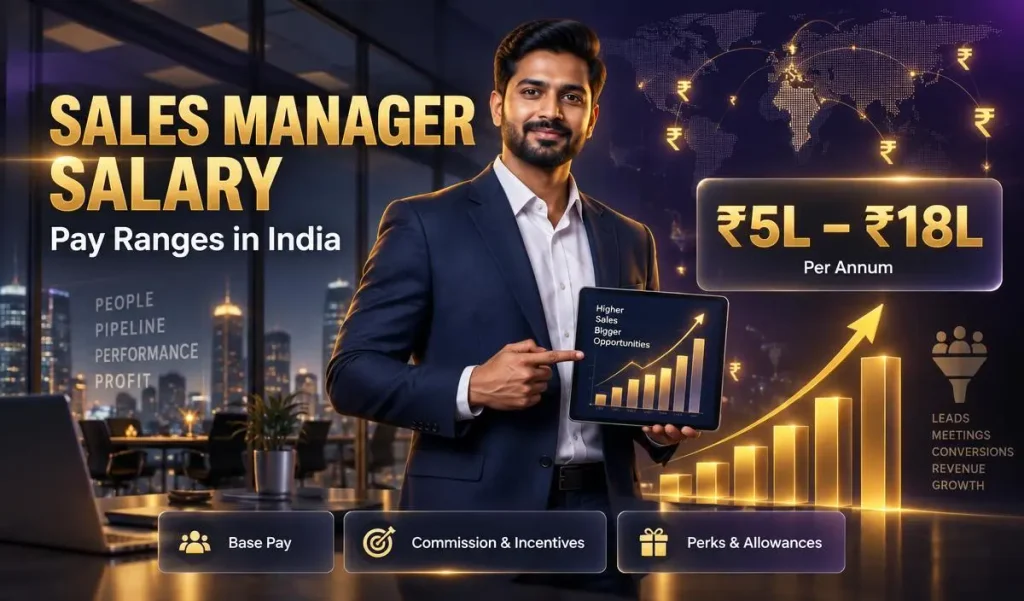
A sales manager leads a company’s sales team, manages customer relationships, sets targets, monitors revenue, and helps the business grow. The role exists across industries such as banking, insurance, FMCG, technology, manufacturing, automobiles, real estate, telecom, retail, and B2B services.
In India, compensation varies considerably by industry, location, experience, company size, and the proportion of performance-linked pay. Private-sector sales managers commonly receive a combination of fixed salary and incentives, while public-sector roles follow the pay structure of the particular organization.
This guide explains the latest available 2026 market figures, CPSE pay structures, location differences, taxes, career progression, entry requirements, and the practical factors that affect take-home earnings.
Who Is a Sales Manager?
A sales manager is responsible for turning sales plans into measurable revenue. Day-to-day work can include setting targets, allocating territories, reviewing sales pipelines, coaching sales representatives, negotiating with customers, preparing forecasts, and reporting results to senior management.
The National Classification of Occupations places sales managers within the broader Sales and Marketing Managers occupational group. The classification includes roles responsible for planning, directing, coordinating, and controlling sales and marketing activities.
The role is especially common in private companies, but comparable sales, marketing, commercial, and business-development positions also exist in public-sector enterprises.
Government Sector Sales Manager Salary
A key point for job seekers is that “Sales Manager” is not a standardized Central Government designation with one universal 7th CPC pay level.
Unlike positions such as many civil-service, technical, or departmental posts, government organizations do not use one nationwide pay matrix specifically called “Sales Manager.” A person performing sales or commercial-management duties in a government-controlled organization may instead be appointed under that organization’s own cadre, executive grade, or departmental designation.
Government-sector salary structure
| Pay component | 2026 position |
| Standard Central Government “Sales Manager salary” | No universal level |
| Applicable pay level | Depends on the recruiting organization/cadre |
| DA/allowances | Organization and applicable government rules |
| Incentive/commission | Depends on the specific post; not universal |
| Take-home salary | Cannot be stated accurately without the organization/pay level |
Important: Giving a single government figure for this title would therefore be misleading. Candidates should check the recruitment notification for the exact department, organization, pay level, allowances, and deductions.
Public-Sector / CPSE Salary
Public-sector employment is different from a normal Central Government department. In Central Public Sector Enterprises (CPSEs), executive positions can follow the Department of Public Enterprises’ 2017 IDA pay scales.
The DPE’s official framework covers board-level and below-board-level executives in CPSEs. For Schedule-A CPSEs, the published basic-pay scales range from E0 through E9. The framework became effective from January 1, 2017, while IDA rates are revised periodically rather than remaining permanently fixed.
A sales manager working in a CPSE may therefore fall into an executive grade determined by the particular enterprise and position. The grade should not be assumed merely from the job title.
CPSE executive pay structure
| CPSE grade | Monthly basic-pay scale | Annualized basic-pay range* |
| E0 | ₹30,000–₹1,20,000 | ₹3.60–₹14.40 lakh |
| E1 | ₹40,000–₹1,40,000 | ₹4.80–₹16.80 lakh |
| E2 | ₹50,000–₹1,60,000 | ₹6.00–₹19.20 lakh |
| E3 | ₹60,000–₹1,80,000 | ₹7.20–₹21.60 lakh |
| E4 | ₹70,000–₹2,00,000 | ₹8.40–₹24.00 lakh |
| E5 | ₹80,000–₹2,20,000 | ₹9.60–₹26.40 lakh |
| E6 | ₹90,000–₹2,40,000 | ₹10.80–₹28.80 lakh |
| E7 | ₹1,00,000–₹2,60,000 | ₹12.00–₹31.20 lakh |
| E8 | ₹1,20,000–₹2,80,000 | ₹14.40–₹33.60 lakh |
| E9 | ₹1,50,000–₹3,00,000 | ₹18.00–₹36.00 lakh |
*Annualized figures are simply the official monthly basic-pay scales multiplied by 12. They are not take-home salary or total CTC. DPE’s official table gives the monthly basic-pay scales.
Actual CPSE compensation can be higher than basic pay because applicable IDA, housing-related benefits, perks, performance-related pay, and other components may apply. DPE continues to publish periodic IDA revisions; its 2025 updates included revision of IDA payments for the 2017 pay scales.
Private-Sector Sales Manager Salary
Private employment provides the clearest market benchmark for this role.
Glassdoor’s India data available in September 2026 reports ₹5 lakh–₹13.5 lakh per year in base pay, with an average base pay of about ₹8 lakh. Average additional pay is approximately ₹2 lakh, with a reported additional-pay range of about ₹96,000–₹7 lakh.
AmbitionBox’s 2025 dataset, based on more than 1.2 lakh reported salaries, places the broader annual range at approximately ₹2.4 lakh–₹16 lakh for employees with about 2–15 years of experience.
Private-sector pay structure
| Compensation measure | Reported India range |
| Base pay, lower reported range | ₹5 lakh/year |
| Average base pay | ₹8 lakh/year |
| Base pay, upper reported range | ₹13.5 lakh/year |
| Average additional pay | ₹2 lakh/year |
| Additional-pay range | ₹0.96–₹7 lakh/year |
| Broad AmbitionBox salary range | ₹2.4–₹16 lakh/year |
The figures above are annual compensation benchmarks, not guaranteed take-home pay. Incentives can make a significant difference in sales because companies may link variable compensation to targets, revenue, collections, new customers, margins, or other performance measures.
B2B sales can also have a different pay profile. AmbitionBox reported a 2025 B2B sales-manager range of ₹2.6 lakh–₹22.5 lakh based on 269 salaries, illustrating how much specialization and industry can change the market.
Pay Variation by Location
Location can materially change the market range. AmbitionBox’s 2025 data shows broad differences between major Indian cities.
| City | Reported annual range |
| Gurugram | ₹3.2–₹22.0 lakh |
| Bengaluru | ₹3.0–₹19.4 lakh |
| Mumbai | ₹3.0–₹18.0 lakh |
| New Delhi | ₹2.9–₹17.0 lakh |
| Noida | ₹3.0–₹17.0 lakh |
| Ahmedabad | ₹2.4–₹17.0 lakh |
| Pune | ₹3.0–₹16.3 lakh |
| Hyderabad | ₹2.5–₹15.3 lakh |
| Chennai | ₹2.5–₹16.0 lakh |
These are market-reporting ranges rather than guarantees. Industry, employer, sales territory, target size, and experience can matter as much as the city itself.
For example, AmbitionBox reports particularly wide ranges in IT Services & Consulting and Manufacturing, while banking and financial-services sales roles show different distributions.
Sales Manager Pay Comparison
| Career level | Indicative reported compensation | Source/qualification |
| Sales Manager — private sector | ₹5–₹13.5 lakh base | Glassdoor India, 2026 |
| Average Sales Manager base | ~₹8 lakh | Glassdoor India, 2026 |
| Additional pay | ~₹2 lakh average | Glassdoor India, 2026 |
| Senior Sales Manager | ₹7–₹18 lakh reported trajectory | Glassdoor India |
| Senior Area Sales Manager | ₹5–₹26.5 lakh | AmbitionBox, 2025 |
| CPSE executive grades | ₹3.6–₹36 lakh annualized basic, depending on E0–E9 | DPE official pay scale |
The CPSE figures should not be compared directly with private CTC because the definitions differ. The DPE figures are basic-pay scales, while private-sector datasets can contain base pay and additional compensation.
Career Progression and Advancement
A common private-sector pathway is:
Sales Executive / Business Development Executive → Senior Sales Executive → Sales Manager → Senior Sales Manager → Area/Regional Sales Manager → National Sales Manager → Sales Head / Business Head
The exact titles differ between industries. A technology company may use Account Manager or Regional Sales Manager, while an FMCG company may use Area Sales Manager, Regional Sales Manager, or Zonal Sales Manager.
Glassdoor’s current salary trajectory shows Sales Manager around ₹5–₹13 lakh and Senior Sales Manager around ₹7–₹18 lakh, although these figures vary by employer and location.
There is no reliable universal rule saying that a manager will be promoted after a fixed number of years. Promotion depends on sales results, leadership ability, territory size, product knowledge, internal vacancies, and company structure.
For CPSEs, progression depends on the enterprise’s executive grades, promotion policies, vacancies, performance systems, and applicable DPE guidelines rather than a single nationwide sales-management ladder.
Benefits and Perks
Private sector
Depending on the employer, the package may include:
- Performance incentives or sales commissions
- Employee provident-fund benefits where applicable
- Group medical insurance
- Paid annual and sick leave
- Travel reimbursement for field sales
- Mobile or communication allowance
- Company vehicle or travel support for some field roles
- Performance bonuses
- Stock or equity at selected companies
Not every employer provides every benefit. Variable pay should be checked carefully before comparing two job offers.
CPSE/public-sector employment
Depending on the enterprise and grade, compensation may include:
- IDA-linked compensation
- Applicable housing/HRA-related benefits
- Medical facilities
- Retirement-related benefits
- Leave benefits
- Performance-related pay
- Other organization-specific allowances and perks
The exact package is determined by the enterprise’s rules and the applicable executive grade.
Deductions and Take-Home Considerations
Annual CTC is not the same as money deposited into a bank account. A private sales manager may have income tax, employee retirement contributions, professional tax where applicable, and other payroll deductions.
For AY 2026–27, India’s new tax regime has a nil rate up to ₹4 lakh, followed by 5%, 10%, 15%, 20%, 25%, and 30% brackets as taxable income rises. The Income Tax Department also states that eligible resident individuals can receive a rebate of up to ₹60,000 where taxable income does not exceed ₹12 lakh under the new regime. A 4% health and education cess applies to income tax plus surcharge.
The new regime is the default regime, although eligible taxpayers can choose the old regime under the applicable rules.
For higher-income sales professionals, surcharge rules can also become relevant. Therefore, a ₹10 lakh CTC, ₹15 lakh CTC, and ₹20 lakh CTC should not be converted directly into monthly take-home by simply dividing the annual figure by 12.
How to Become a Sales Manager in India
There is no single national examination required to become a private-sector sales manager.
A common route is:
- Complete a bachelor’s degree in a relevant field such as business, commerce, management, economics, or another discipline accepted by the employer.
- Start in sales, business development, retail, distribution, customer acquisition, or a related position.
- Build measurable experience in meeting sales targets.
- Develop negotiation, communication, CRM, forecasting, and team-management skills.
- Move into a team-lead or supervisory position.
- Apply for Sales Manager or equivalent management roles.
An MBA can be useful for some corporate sales-management positions, especially in B2B, technology, consulting, financial services, and larger organizations, but it is not a universal requirement.
The National Classification of Occupations also identifies sales-management occupations across different industries, including retail and media-related sales-management positions.
For CPSE positions, the recruitment method depends on the specific enterprise. Candidates should follow the individual CPSE’s vacancy notice rather than assuming there is one common “Sales Manager” examination.
Which Sector Should You Choose?
Private-sector sales management generally offers a compensation structure with greater exposure to incentives and faster changes in role or responsibility, but earnings can depend heavily on targets and employer performance.
CPSE employment uses a more structured executive-grade framework, with applicable IDA and organization-specific benefits, but the available roles and promotion structures depend on the enterprise.
A generic Central Government sales-manager post is not a standardized career category, so candidates seeking government employment should compare the actual department and pay level rather than the job title alone.
The right choice depends on whether you prioritize variable earning potential, structured compensation, organizational stability, industry specialization, or faster role changes.
FAQs
1. What is a typical sales manager’s pay in India in 2026?
Current private-sector datasets show a broad market. Glassdoor reports an average base of about ₹8 lakh per year, with base pay around ₹5–₹13.5 lakh and average additional pay of about ₹2 lakh. AmbitionBox’s broader 2025 dataset reports approximately ₹2.4–₹16 lakh.
2. Is incentive pay included in the advertised package?
It depends on the employer. Some companies quote fixed CTC separately from variable incentives, while others combine fixed and variable components into total compensation. Always ask for the fixed salary, target incentive, maximum incentive, and conditions for receiving it.
3. Which industries hire sales managers?
Common employers include banking, insurance, FMCG, automobiles, manufacturing, technology, telecom, real estate, education, healthcare, retail, and B2B services. Compensation can differ substantially between these industries.
4. Can a graduate become a sales manager without an MBA?
Yes. An MBA is not a universal requirement. Many professionals reach management after building strong sales experience and demonstrating leadership and target achievement. Some larger employers may prefer an MBA or equivalent management qualification.
5. Is there a government Sales Manager post with a fixed salary?
There is no single nationwide Central Government pay level titled “Sales Manager.” Government-controlled organizations can have sales or commercial positions under organization-specific structures, so the exact recruitment notification must be checked.
6. How can I increase my earning potential?
Developing expertise in B2B sales, enterprise accounts, technology products, financial services, key-account management, negotiation, sales analytics, CRM systems, and team leadership can open different career paths. Location and employer size can also materially affect compensation.
Conclusion
Sales management in India offers several career routes across private companies and public-sector enterprises, but compensation depends strongly on the employer, industry, location, experience, and variable-pay structure. For financial planning, compare fixed pay, realistic incentives, benefits, tax deductions, and career progression rather than looking only at the headline CTC.