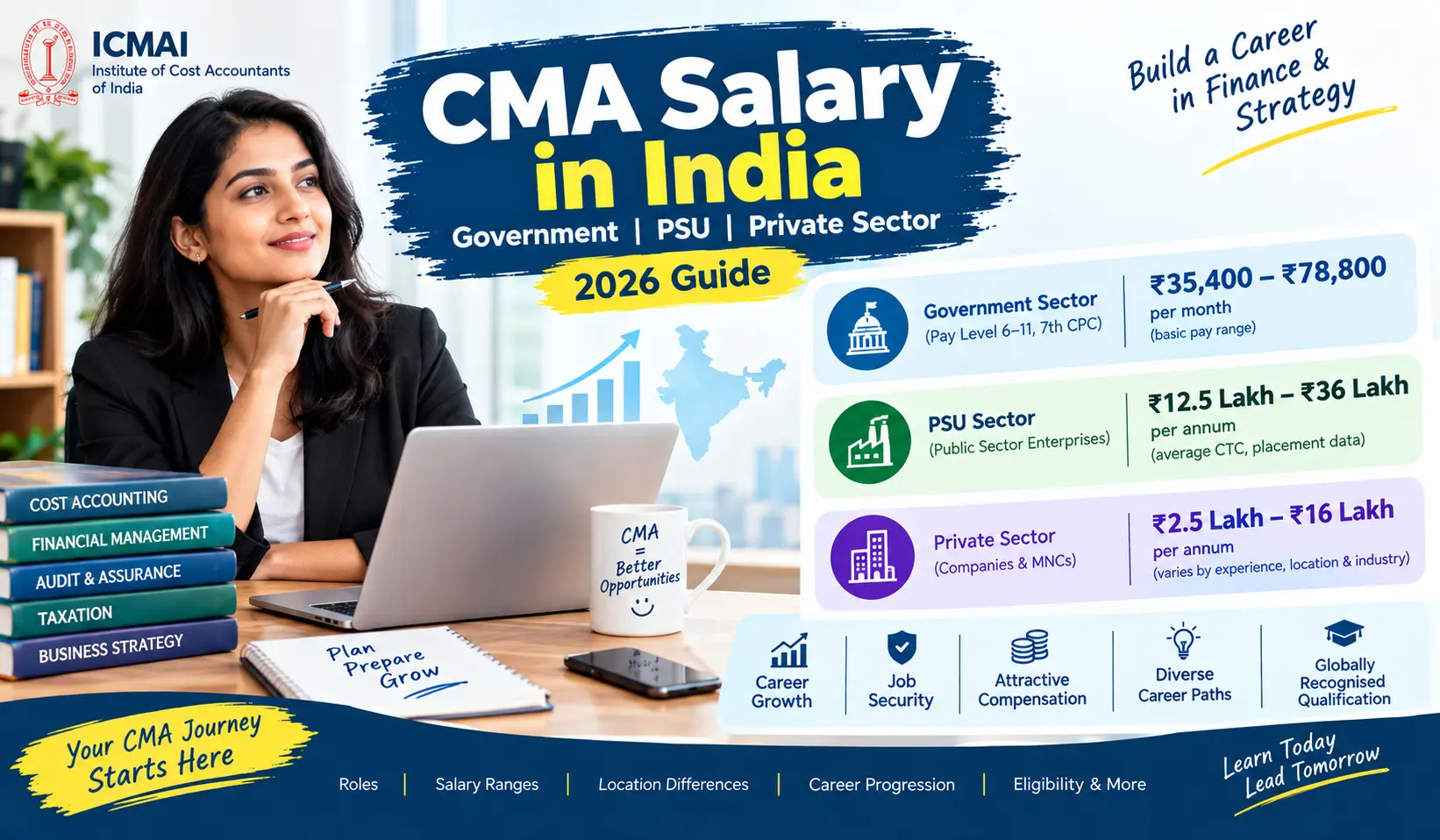
A Cost and Management Accountant (CMA) in India works mainly in costing, management accounting, budgeting, financial analysis, cost control, internal reporting, taxation, audit support and business decision-making. The qualification is awarded by the Institute of Cost Accountants of India (ICMAI), a statutory professional body under the Ministry of Corporate Affairs.
CMAs can build careers in private companies, manufacturing, banking, consulting, FMCG, energy and other industries. They can also work with public-sector enterprises and, depending on the recruitment rules, government departments and autonomous bodies.
This guide explains the 2026 compensation landscape, location differences, government and PSU pay structures, career progression, deductions, eligibility and the practical route into the profession.
Who is a Cost and Management Accountant?
A CMA helps an organization understand where money is being spent, how much products or services cost, and how financial performance can be improved.
Typical responsibilities include:
- Cost accounting and product costing
- Budget preparation and monitoring
- Variance analysis
- Cost control and cost reduction
- Management reporting
- Financial planning and analysis
- Internal controls and audit support
- Cost audit and compliance
- Pricing and profitability analysis
- Working with finance, operations and senior management
The role is especially relevant in manufacturing, power, infrastructure, oil and gas, FMCG, banking, consulting and large corporate organizations. ICMAI’s current placement activity also shows recruitment across manufacturing, finance, consulting, FMCG, energy, infrastructure, banking and other sectors.
Government Sector Salary
A cma salary in India does not automatically receive a particular government salary simply because they hold the qualification. Central and state governments recruit against specific posts, and the pay depends on the post, department, pay level and recruitment rules.
For Central Government employment, the Seventh Central Pay Commission pay matrix remains the underlying reference structure. For example, the official matrix lists ₹56,100 at Level 10 and ₹67,700 at Level 11 as the first-cell basic pay. Higher cells increase with annual progression and promotion.
Government pay structure
| Component | 2026 position | Source / status |
| Pay Level 10 basic | ₹56,100/month starting cell | Official 7th CPC Pay Matrix |
| Pay Level 11 basic | ₹67,700/month starting cell | Official 7th CPC Pay Matrix |
| Dearness Allowance | Additional percentage of basic pay | Government rate, revised periodically |
| HRA | Depends on applicable rules and posting | Government rules |
| Transport/other allowances | Depends on post and eligibility | Government rules |
| Gross pay | Basic + applicable allowances | Calculated according to post |
| Take-home | Gross pay minus applicable deductions | Employee-specific |
The Department of Expenditure continues to issue periodic revisions to Dearness Allowance. Therefore, DA should not be treated as a permanent 2026 figure.
Importantly, these figures describe government pay levels, not a guaranteed CMA salary. A CMA appointed to a government post receives the scale attached to that post.
Public-Sector / PSU Salary
Public-sector enterprises are a particularly important career option for CMAs. ICMAI’s placement records show organizations such as Power Finance Corporation, ONGC, BPCL, GAIL, REC, IRFC, NMDC and Indian Oil among organizations that have recruited through CMA placement programmes.
ICMAI reported that its June 2025 campus-placement material recorded an average CTC of ₹12.5 lakh for the relevant campus programme, while the highest offer for that programme was ₹36 lakh from Trident Group. The June 2024 term’s highest offer was ₹26.5 lakh from Power Finance Corporation.
These are placement outcomes, not guaranteed salaries for every CMA.

PSU compensation structure
| Career situation | Indicative compensation evidence | Pay type |
| CMA campus placement average | ₹12.5 lakh CTC | CTC |
| Highest offer reported in June 2025 placement material | ₹36 lakh CTC | CTC |
| Highest offer in June 2024 term | ₹26.5 lakh CTC | CTC |
| Experienced PSU finance roles | Depends on employer grade | Basic + allowances/benefits |
| Senior PSU management | Employer-specific | CTC / executive compensation |
For comparison, REC’s recruitment history demonstrates that CMA/Cost Accountant qualifications can be accepted for finance positions. One REC transmission-project recruitment advertisement, for example, listed CMA/CA as an accepted qualification for a finance position with a consolidated monthly remuneration of ₹75,000, subject to the advertised experience requirements.
PSU packages may include basic pay, DA, HRA or accommodation, medical benefits, retirement-related benefits, performance-related components and other company-specific benefits. The exact structure varies by PSU and employment grade.
Private-Sector Salary
Private-sector compensation is much less standardized. Employer size, industry, city, experience, technical skills and the level of responsibility can make a major difference.
AmbitionBox’s June 2025 data, based on 172 reported salaries, showed Cost and Management Accountant compensation ranging from ₹2.5 lakh to ₹16 lakh per year across less than one year to 11 years of experience.
Glassdoor’s India data showed base pay of approximately ₹2 lakh to ₹11.2 lakh per year, with an average base-pay figure around ₹10 lakh on its current listing. Because salary platforms use different samples and methodologies, these figures should be treated as market indicators rather than an official salary scale.
Private-sector pay structure
| Career stage / market indicator | Annual compensation | Pay type |
| Lower end of reported market | ₹2.5 lakh | Salary |
| Upper end of broad reported market | ₹16 lakh | Salary |
| Glassdoor base-pay range | ₹2 lakh–₹11.2 lakh | Base pay |
| TCS, 2–5 years | ₹4 lakh–₹8.1 lakh | Annual salary |
| Hindustan Unilever, reported sample | ₹9 lakh–₹11.5 lakh | Annual salary |
| Specialized/senior positions | Can exceed broad market ranges | Employer-specific |
The TCS figure is based on five reported salaries, while the HUL figure has low confidence because of the small sample. These examples show why a company-specific number should not be treated as the market rate for every CMA.
Private compensation can also contain annual bonuses, incentives, joining bonuses, variable pay or equity in some organizations. These components are not guaranteed and can change with performance and employer policy.
Pay Variation by Location
Location can make a significant difference, particularly in the private sector. AmbitionBox’s 2025 data provides the following city-level ranges.
| Location | Reported annual range |
| Mumbai | ₹4.2 lakh–₹13 lakh |
| Chennai | ₹5.2 lakh–₹9 lakh |
| Kolkata | ₹3 lakh–₹10.4 lakh |
| New Delhi | ₹2.5 lakh–₹8.5 lakh |
| Hyderabad/Secunderabad | ₹1.2 lakh–₹10.5 lakh |
| Bangalore | ₹2.2 lakh–₹9.5 lakh |
These ranges come from different sample sizes and experience profiles, so they should not be interpreted as a direct ranking of cities.
Mumbai, Bengaluru, Delhi-NCR, Chennai and Hyderabad have strong corporate finance markets, but higher salaries can be offset by higher housing and living costs. Remote roles can reduce commuting costs, while on-site manufacturing and plant roles may include location-specific allowances.
For government employment, location can also affect allowances such as HRA and other benefits under the applicable rules.
CMA Compensation Comparison
| Career route | Typical evidence | Main advantage |
| Central Government | Pay-matrix based; e.g. Level 10 starts at ₹56,100 basic | Structured pay and benefits |
| PSU | ICMAI campus average CTC ₹12.5 lakh in cited programme | Strong compensation potential plus public-sector benefits |
| Private sector | Broad reported market ₹2.5–₹16 lakh | Faster movement between companies and industries |
| High-end private/PSU placement | Offers can reach ₹26.5–₹36 lakh in reported ICMAI placement data | Strong upside for competitive candidates |
These figures are not directly equivalent because government figures are basic pay, while placement figures are generally CTC.
Career Progression and Advancement Path
CMA salary in India does not follow one fixed promotion timetable. Progress depends on the employer, performance, technical ability and the kind of finance role you choose.
A common private-sector pathway is:
CMA Trainee / Finance Executive → Cost Accountant / Management Accountant → Assistant Manager → Manager → Senior Manager → Financial Controller / Head of Finance → CFO-level leadership
A reasonable planning assumption is:
| Stage | Typical experience* | Main responsibility |
| Trainee / Entry finance role | 0–2 years | Reporting, costing, analysis |
| Executive / Analyst | 1–4 years | Independent finance work |
| Assistant Manager | 3–6 years | Team/process ownership |
| Manager | 5–10 years | Business partnering and leadership |
| Senior Manager / Controller | 8–15+ years | Large functions or business units |
| Finance Head / CFO track | 12–20+ years | Strategic financial leadership |
*These are planning ranges, not guaranteed promotion timelines.
Experienced CMAs can specialize in FP&A, cost transformation, business finance, controllership, taxation, internal audit, cost audit, risk management or strategic finance.
Benefits and Perks
Government
Depending on the post and rules, government employment can include:
- Dearness Allowance
- House Rent Allowance or applicable accommodation arrangements
- Transport-related benefits
- Leave benefits
- Retirement benefits under the applicable government retirement system
- Medical and other employee benefits
- More structured promotion and service rules
Government employment generally provides more predictable service conditions than many private employers, but it is not completely immune to organizational changes or performance requirements.
PSU
PSU packages can include:
- Basic salary and DA
- HRA or company accommodation
- Medical benefits
- Retirement-related benefits
- Performance-related pay
- Leave and travel-related benefits
- Other employer-specific allowances
Private sector
Benefits depend heavily on the employer. They may include:
- Employer-provided health insurance
- Provident Fund
- Paid leave
- Performance bonus
- Variable pay
- Gratuity where applicable
- Remote or hybrid work
- Learning and certification support
- Stock or equity incentives at selected companies
Deductions and Take-Home Considerations
Annual CTC is not the same as monthly take-home pay.
For private-sector employees covered by EPF, the employee contribution is generally 12% of applicable EPF wages, subject to the statutory rules and applicable wage ceiling/contribution arrangements. Employer contributions form part of the overall employment cost but do not normally arrive as cash in the employee’s monthly bank account.
Income tax is another major variable.
For AY 2026–27, the Income Tax Department lists the following new-regime slabs for individuals below 60:
| Taxable income | New-regime rate |
| Up to ₹4 lakh | Nil |
| ₹4–8 lakh | 5% |
| ₹8–12 lakh | 10% |
| ₹12–16 lakh | 15% |
| ₹16–20 lakh | 20% |
| ₹20–24 lakh | 25% |
| Above ₹24 lakh | 30% |
The new regime also provides a rebate of up to ₹60,000 where the relevant taxable-income condition is satisfied. Health and education cess is charged at 4% of income tax plus applicable surcharge.
Tax rules can change through annual Finance Acts. Employees should calculate tax based on the applicable assessment year rather than using an old salary calculator.
How to Enter This Field and Get the Job
The professional route is administered by ICMAI.
For the Foundation route, students can enter after Class 10, although they must meet the required education conditions before appearing for the examination. Graduates can generally obtain direct admission to the Intermediate Course, subject to ICMAI’s eligibility rules.
The broad route is:
Class 10/12 → CMA Foundation where applicable → CMA Intermediate → CMA Final → Practical Training → Membership
ICMAI’s current course information lists graduates of recognized universities among those eligible for Intermediate registration. The current training scheme includes skills training and 15 months of practical training, with practical training capable of starting at the Intermediate level.
Candidates should also develop practical skills in:
- Advanced Excel
- ERP systems such as SAP
- Power BI and data analytics
- Financial modelling
- Costing and budgeting
- GST and taxation
- Financial reporting
- Business communication
For private companies, recruitment normally involves CV screening, aptitude or technical assessment and interviews. Campus recruitment through ICMAI is another route.
For government jobs, the process depends on the specific vacancy. A CMA qualification may be listed as an essential or desirable qualification, but the candidate must satisfy the post’s experience, age and recruitment requirements. There is no universal “CMA government exam” that automatically leads to a government posting.
Which Sector Should You Choose?
Choose the government route if structured pay, service rules and long-term employment conditions matter more to you than rapid salary jumps. The PSU route can offer a strong middle ground, combining relatively structured employment with potentially attractive compensation.
The private sector usually provides the widest range of industries and can offer faster salary progression for CMAs who develop strong analytical, ERP, FP&A and business-partnering skills. Your choice should therefore depend on whether your priority is stability, compensation upside, specialization or speed of career growth.
FAQs
1. Is CMA a high-paying career in India?
It can be, but the qualification alone does not guarantee a high package. Employer, industry, location, experience and practical skills have a major effect. ICMAI’s placement data demonstrates that some candidates receive very strong offers, while broader market salary data shows a much wider range.
2. Can a CMA work in a government job?
Yes. CMAs can qualify for government and autonomous-body finance, accounts, costing, audit and related positions when the recruitment notification accepts the qualification. However, the salary is determined by the particular post and pay level, not simply by holding CMA membership.
3. Are PSU jobs better than private CMA jobs?
Not automatically. PSUs can provide structured compensation and strong benefits, while private companies may offer faster promotions, broader industry exposure and greater salary mobility. The better choice depends on your career priorities.
4. What can a fresher expect after completing CMA?
There is no single reliable fresher figure for the whole market. ICMAI’s placement programmes provide useful evidence of campus outcomes, but offers vary considerably by company and role. A candidate should evaluate the actual CTC, fixed pay, variable pay, location and benefits rather than looking only at the headline package.
5. Does location affect CMA compensation?
Yes. Mumbai, Bengaluru, Delhi-NCR, Chennai and Hyderabad have large corporate finance markets, but reported compensation varies significantly even within the same city. Cost of living should also be considered before choosing a job solely because its CTC is higher.
6. What skills can increase a CMA’s earning potential?
Costing expertise remains important, but modern finance employers also value FP&A, financial modelling, Excel, ERP systems, Power BI, data analytics, taxation, business partnering and communication. Moving from routine accounting into analytical and strategic finance can broaden career opportunities.
Conclusion
CMA offers several career routes in India rather than one fixed salary path. Government employment provides structured pay, PSUs can offer strong compensation and benefits, while private companies provide the widest range of industries and potentially faster salary growth.
For career planning, compare the fixed salary, CTC, variable pay, benefits, location, tax deductions and long-term promotion opportunities instead of choosing an employer based only on its advertised package.