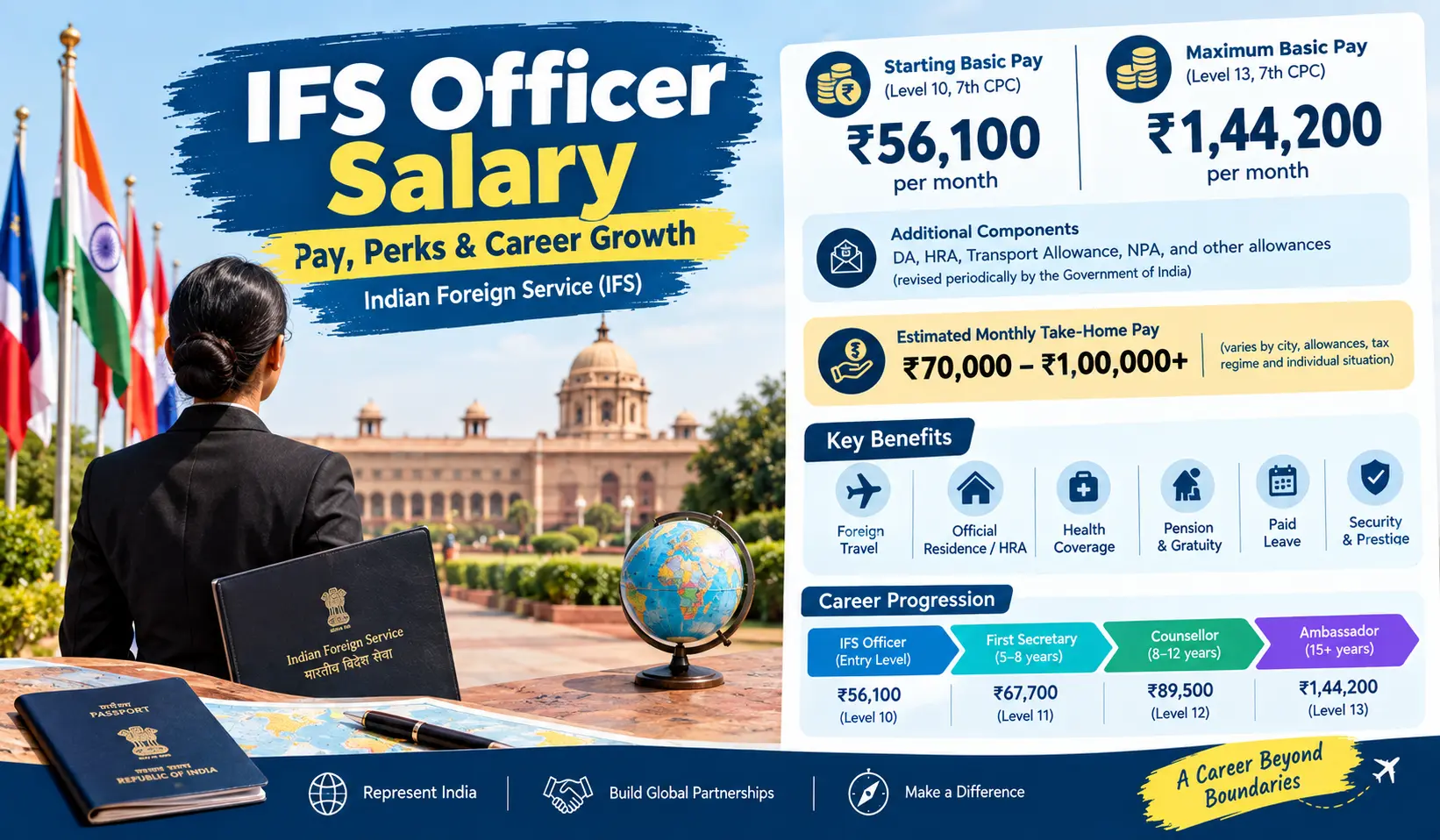
An Indian Foreign Service (IFS) officer is a career diplomat who represents India abroad and works on foreign policy, international relations, consular affairs, trade and other diplomatic responsibilities. The service is administered through the Ministry of External Affairs (MEA), with entry primarily through the UPSC Civil Services Examination.
Unlike many careers, there is one primary employment sector here: the Central Government. The important distinction is not government versus private salary, but the difference between an officer’s basic pay in the Indian pay matrix and the additional allowances that can apply during overseas postings.
This guide explains the verified 2026 pay structure, overseas compensation, career progression, benefits, taxation and the actual route to becoming an IFS officer salary.
Who Is an IFS Officer?
An Indian Foreign Service officer is part of India’s diplomatic machinery. Officers can serve at the Ministry of External Affairs headquarters in India and at Indian embassies, high commissions, consulates and other missions overseas.
The work can involve political and economic reporting, negotiations, consular services, public diplomacy, international organizations, trade and investment matters, bilateral relations and assistance to Indian citizens abroad.
The MEA states that IFS entrants are recruited through the UPSC Civil Services Examination. After selection, they undergo specialized training before being assigned a compulsory foreign language and eventually serving at an Indian mission abroad.

Government Sector ifs officer Salary Structure
The official IFS pay structure follows the 7th Central Pay Commission pay matrix. The entry point is Junior Scale, Level 10, with basic pay of ₹56,100 per month.
Importantly, this ₹56,100 figure is basic pay, not take-home salary. An officer’s actual monthly earnings can be higher after applicable allowances, while deductions such as tax and NPS reduce the amount actually received.
The MEA’s IFS rules specify the following grades and pay levels.
IFS pay matrix by grade
| IFS grade | Typical designation/responsibility | Pay Matrix Level | Basic pay range |
| Junior Scale | Under Secretary at HQ / Second or Third Secretary abroad | Level 10 | ₹56,100–₹1,77,500 |
| Senior Scale | Under Secretary at HQ / First or Second Secretary abroad | Level 11 | ₹67,700–₹2,08,700 |
| Junior Administrative Grade | Deputy Secretary / First Secretary abroad | Level 12 | ₹78,800–₹2,09,200 |
| Grade IV | Director / Counsellor / Head of Post | Level 13 | ₹1,23,100–₹2,15,900 |
| Grade III | Joint Secretary / Minister-level diplomatic assignment | Level 14 | ₹1,44,200–₹2,18,200 |
| Grade II | Additional Secretary / senior Head of Mission roles | Level 15 | ₹1,82,200–₹2,24,100 |
| Grade I | Secretary / senior Head of Mission | Level 17 | ₹2,25,000 fixed |
Source: Ministry of External Affairs IFS rules and pay-matrix schedule. These are basic-pay figures, not net salary.
What does a new IFS officer earn?
A newly appointed officer enters at Level 10 with ₹56,100 basic pay per month.
That equals ₹6,73,200 in annual basic pay before adding applicable allowances. It is important not to describe ₹56,100 as the officer’s complete salary because the actual gross and take-home figures depend on the posting and applicable allowances.
Foreign Posting Allowances
One of the biggest differences between the Indian Foreign Service and many other Central Government careers is the possibility of an overseas posting.
IFS officers serving at Indian missions abroad receive Foreign Allowance in addition to their Indian pay-matrix salary. The applicable amount is not one universal number for every officer or every country. It is determined according to the foreign station and applicable government rules and can be revised periodically.
Therefore, online claims such as “every IFS officer earns ₹X lakh per month abroad” should be treated cautiously unless they identify the specific station and current allowance rules.
The government’s IFS rules specifically provide for Foreign Allowance for officers serving at Indian embassies and consulates abroad.
India posting vs overseas posting
| Compensation element | Posting in India | Posting abroad |
| Basic pay | Applicable 7th CPC level | Same underlying pay-matrix structure |
| Dearness Allowance | Applicable under current government rates | Applicable according to rules |
| House-related benefits | Depends on entitlement and accommodation | Depends on mission/station arrangements |
| Foreign Allowance | Not applicable as an overseas allowance | Applicable according to foreign-posting rules |
| Travel-related benefits | Government rules apply | Government rules apply |
| NPS/retirement deductions | Applicable as prescribed | Applicable as prescribed |
| Income tax | Subject to applicable tax rules | Tax treatment depends on applicable rules and circumstances |
The key point is that foreign allowance is variable. It should not be treated as a permanent addition to the Level 10 basic salary.
Pay Variation by Location
For an IFS officer, location affects compensation in a different way from a private-sector employee.
A private employee may receive a higher salary simply because they work in Mumbai or Bengaluru. For an IFS officer, the more important distinction is generally domestic headquarters posting versus a particular foreign mission, because overseas compensation includes station-specific allowances and benefits.
| Posting type | Main salary consideration | Can compensation vary? |
| MEA headquarters, New Delhi | Pay matrix + applicable domestic allowances | Yes |
| Indian embassy/high commission abroad | Pay matrix + foreign allowance and applicable benefits | Yes |
| Indian consulate abroad | Pay matrix + foreign allowance and applicable benefits | Yes |
| Senior diplomatic mission | Higher pay level as officer progresses + applicable foreign-posting benefits | Yes |
There is therefore no reliable single “IFS foreign salary” figure for every country. The station, grade and current allowance rules all matter.
Comparison Across IFS Career Levels
Because this is a government-only profession, the most useful comparison is between the different career grades.
| Career level | Basic monthly pay at the start of the level | Maximum basic pay in level |
| Level 10 | ₹56,100 | ₹1,77,500 |
| Level 11 | ₹67,700 | ₹2,08,700 |
| Level 12 | ₹78,800 | ₹2,09,200 |
| Level 13 | ₹1,23,100 | ₹2,15,900 |
| Level 14 | ₹1,44,200 | ₹2,18,200 |
| Level 15 | ₹1,82,200 | ₹2,24,100 |
| Level 17 | ₹2,25,000 | ₹2,25,000 fixed |
Source: MEA’s published IFS pay structure.
This table should not be interpreted as a guaranteed promotion timetable. Movement between grades is governed by service rules, vacancies, eligibility and promotion processes.
Career Progression and Advancement Path
An IFS career can move between headquarters assignments in New Delhi and diplomatic postings overseas.
A simplified progression is:
IFS Officer Trainee → Junior Scale → Senior Scale → Junior Administrative Grade → Grade IV → Grade III → Grade II → Grade I
The designations change with the assignment. An early-career officer may serve as a Third Secretary or Second Secretary abroad, while later assignments can include First Secretary, Counsellor, Minister and senior Head-of-Mission responsibilities.
The MEA’s training institute also runs mandatory mid-career programmes. For example, its current information identifies MCTP-I with preparation for officers moving toward Deputy Secretary-level responsibilities, while MCTP-II is associated with Grade IV/Director-level officers and MCTP-III with Grade III/Joint Secretary-level officers.
The MEA does not provide a simple guaranteed “X years = promotion” schedule that should be used as a salary calculator. Actual progression depends on service rules, vacancies and career circumstances.
Benefits and Perks
The financial value of the service is broader than basic pay.
Depending on the assignment and applicable rules, an IFS officer may receive benefits connected with:
- Government accommodation or housing-related entitlement
- Travel allowances
- Leave Travel Concession and other applicable leave benefits
- Medical facilities
- National Pension System benefits
- Foreign Allowance during eligible overseas postings
- Official travel connected with diplomatic duties
- Mission-related facilities and support
The exact package varies with the officer’s grade and posting.
The overseas component is particularly important. An officer stationed abroad may have access to allowances and facilities designed around the costs and requirements of diplomatic service at that location.
However, these benefits should not be converted into a fixed cash salary without checking the applicable rules for the specific country and assignment.
Training and Work Life
IFS training is extensive because the job involves more than formal government administration.
The Sushma Swaraj Institute of Foreign Service states that the induction training period in India for IFS Officer Trainees is one year. It includes a three-month Foundation Course at LBSNAA followed by specialized training.
The MEA also explains that after training, officers receive a compulsory foreign language and undertake language training connected with their first overseas assignment.
The lifestyle can be attractive for people who enjoy international affairs, languages and diplomacy. But it also requires adaptability because officers can be transferred between countries and assignments, sometimes with significant changes in work environment.
Deductions and Take-Home Considerations
Basic pay is not the same as take-home salary.
An IFS officer’s payslip can be affected by:
- Income-tax/TDS
- NPS contribution
- Applicable government deductions
- Professional tax where applicable
- Other authorized recoveries or deductions
For Assessment Year 2026–27, India’s new tax regime is the default regime for eligible individuals, although eligible taxpayers can opt for the old regime under the applicable rules. The Income Tax Department lists the new-regime slabs as nil up to ₹4 lakh, followed by 5%, 10%, 15%, 20%, 25% and 30% bands as income increases.
The Income Tax Department also states that the Section 87A rebate under the new regime increased to ₹60,000 for eligible taxpayers with total income up to ₹12 lakh from AY 2026–27.
These tax rules are separate from the government’s pay matrix and can change through subsequent Finance Acts. Therefore, a precise “IFS in-hand salary” should always be calculated using the officer’s actual taxable income, allowances, deductions and tax regime rather than simply subtracting a fixed percentage from basic pay.
How to Become an IFS Officer in India
The primary route is the UPSC Civil Services Examination (CSE).
Step 1: Complete a bachelor’s degree
The 2026 CSE rules require a recognized graduate degree or equivalent qualification. The subject does not have to be political science, international relations or another specific humanities discipline.
Engineering, medicine, commerce, law, science and humanities graduates can therefore compete, subject to the UPSC eligibility rules.
Step 2: Meet the nationality and age requirements
For the Indian Foreign Service, the candidate must be an Indian citizen.
For CSE 2026, the general age requirement is 21 to under 32 years on 1 August 2026, with prescribed relaxations for eligible categories. The official 2026 rules specify the relevant birth-date range and category-based relaxations.
Step 3: Clear the UPSC Civil Services Examination
The examination has three major stages:
- Civil Services Preliminary Examination
- Civil Services Main Examination
- Personality Test/Interview
The final service allocation depends on performance, rank, preferences and the applicable allocation rules.
The UPSC’s 2026 examination cycle is active, with the Commission publishing the 2026 Preliminary Examination results and subsequent examination information on its website.
Step 4: Complete IFS training
After selection and allocation to the service, the officer enters the IFS training system. The programme includes common civil-service training, specialist diplomatic training and foreign-language preparation.
Which Career Path Should You Choose?
There is no private-sector alternative to compare directly with the IFS pay matrix because the Indian Foreign Service is a specific Central Government service. Its strongest advantages are structured pay progression, diplomatic responsibilities, government benefits and the possibility of representing India overseas.
The trade-offs are significant. The UPSC entry barrier is extremely high, transfers are part of the career, overseas assignments can require frequent adaptation, and personal plans may need to accommodate postings in different countries.
If your main goal is the highest possible income immediately, this may not be the most predictable route. If you value public service, international affairs, diplomacy, structured career progression and overseas exposure, the career can be highly rewarding.
FAQs
What is the starting basic pay of an IFS officer in 2026?
The entry-level IFS position is Level 10, with a basic pay of ₹56,100 per month under the published pay matrix. This is basic pay, not the officer’s final take-home amount.
Do IFS officers get a foreign allowance?
Yes. IFS officers serving at Indian embassies and consulates abroad are entitled to Foreign Allowance under the applicable rules. The amount varies according to the overseas posting and applicable government provisions, so there is no single universal foreign-allowance figure.
Is the ifs officer salary higher than IAS salary?
Both services use the Central Government pay-matrix framework, so equivalent levels have comparable basic-pay structures. The major difference for an IFS officer can arise from overseas postings and the associated Foreign Allowance and mission-related benefits.
Can an IFS officer become an ambassador?
Senior IFS officers can serve as Heads of Mission, including ambassadorial positions, depending on appointment and career progression. The MEA’s published structure includes senior Head-of-Mission responsibilities within the higher IFS grades.
Is there a separate exam for Indian Foreign Service?
No. Candidates normally enter the Indian Foreign Service through the UPSC Civil Services Examination, rather than a separate IFS entrance examination. The MEA confirms that the combined Civil Services Examination has been the standard intake route.
Can a graduate from any stream apply?
Generally, yes. The UPSC CSE requires a recognized bachelor’s degree or equivalent qualification rather than a specific IFS-related academic subject. Candidates must also satisfy the nationality, age and other examination requirements.
Conclusion
The 2026 ifs officer salary structure starts at ₹56,100 basic per month at Level 10 and progresses through higher government pay levels as officers advance. The overall compensation can become substantially different during overseas assignments because Foreign Allowance and other posting-related benefits depend on the location and applicable rules.
For an aspirant, the key attraction is not simply the starting pay. It is the combination of a structured Central Government career, diplomatic responsibility, international postings and long-term progression through the Ministry of External Affairs.