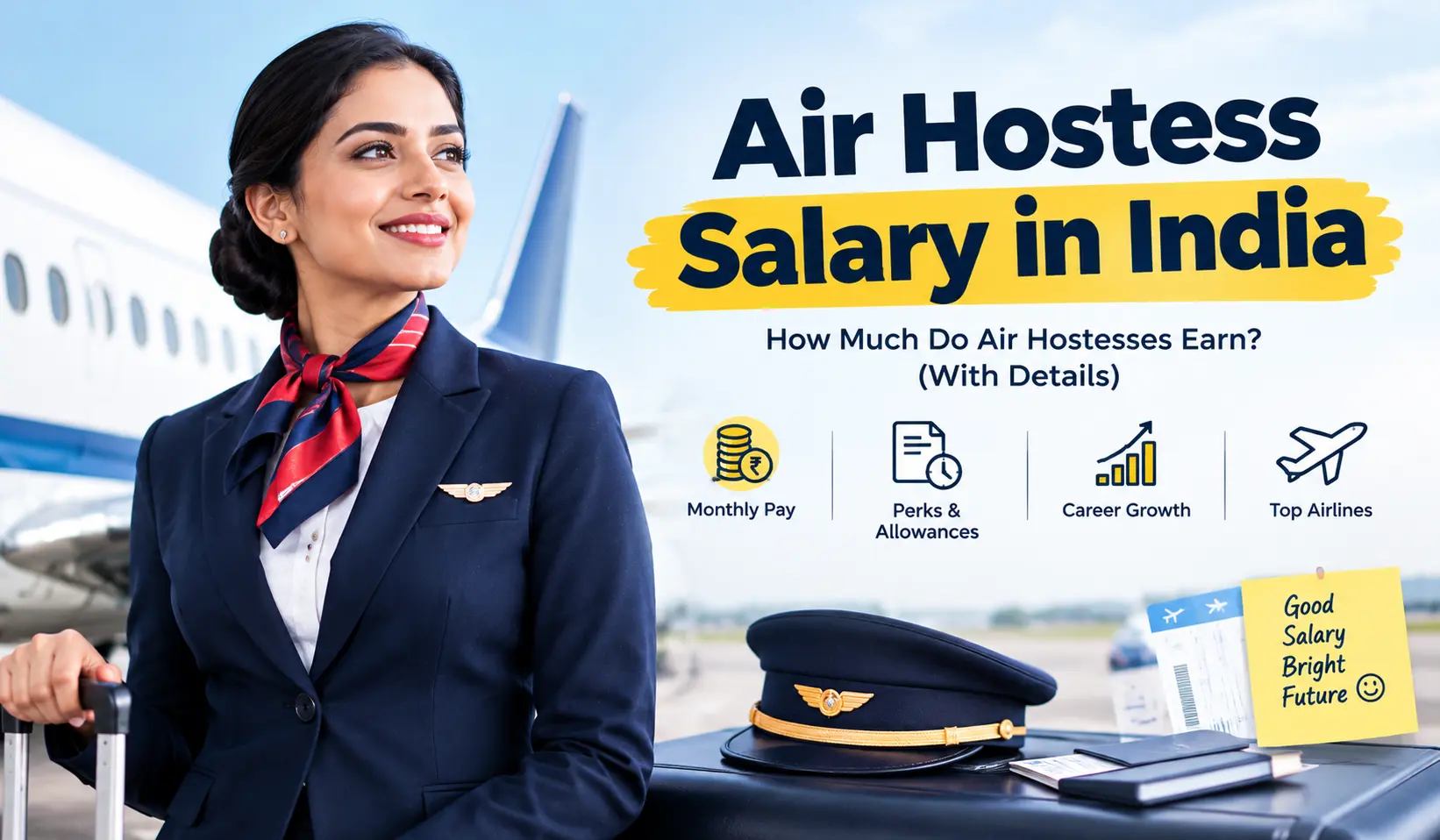
Working as a cabin crew is one of the most visible careers in the aviation industry. The job combines passenger service, safety procedures, emergency response, hospitality and strict operational discipline. Although the term “air hostess” is still widely used, airlines generally use titles such as cabin crew, cabin attendant or flight attendant.
Pay varies considerably between airlines. Flying hours, domestic or international operations, experience, seniority, allowances and the airline’s employment structure can all affect monthly earnings. This guide separates public-sector aviation from private airlines and explains the realistic compensation, career path, benefits and entry requirements for 2026.
Who Is an Air Hostess or Cabin Crew Member?
A cabin crew member is responsible for passenger safety and service throughout a flight. The work starts before take-off with safety and cabin checks and continues through boarding, in-flight service, emergency readiness and post-flight procedures.
Indian aviation regulations require cabin crew members to be at least 18 years old, have completed 10+2 from a recognised board or university, pass the required medical assessment and be competent to perform their assigned safety duties.
The role exists across domestic airlines, international airlines operating in India and regional carriers. It is not limited to women; airlines such as Air India recruit both male and female cabin crew.
Public-Sector Airline Salary
Alliance Air Salary Structure
India does not have a universal government “air hostess pay scale” comparable to the pay matrix used for civil-service posts. A notable public-sector example is Alliance Air Aviation Limited (AAAL), which is a wholly owned subsidiary of AI Assets Holding Limited, a Government of India undertaking under the Ministry of Civil Aviation.
Alliance Air’s published RTI remuneration information lists Cabin Crew remuneration of ₹36,175 per month for up to 65 hours of flying. This is a company-specific remuneration figure, not a 7th Pay Commission salary. The amount can therefore differ from what an individual employee actually receives when flying hours, employment conditions or company revisions change.
| Pay component | Public-sector example | What it means |
| Cabin Crew remuneration | ₹36,175/month | Published Alliance Air figure for up to 65 flying hours |
| Annualised equivalent | About ₹4.34 lakh/year | ₹36,175 × 12; simple annualisation, not a guaranteed CTC |
| Flying-hour effect | Variable | The published figure is specifically tied to flying hours |
| Employment structure | Company-specific | Alliance Air has used contractual employment structures rather than a standard civil-service cadre |
Source: Alliance Air RTI remuneration disclosure. The published figure should be treated as the current disclosed company remuneration benchmark, not as a universal government salary.
Alliance Air’s service regulations also provide a defined progression route for fixed-term cabin crew. The published framework provides progression from Cabin Crew to Senior Cabin Crew, Deputy Cabin Crew, Chief Cabin Crew and then Assistant Manager (IFS), subject to the stated service and suitability conditions.
Benefits in the Public-Sector Airline Environment
Benefits depend on the applicable contract and company rules. Alliance Air’s published recruitment material for other aviation employees confirms benefits such as provident fund, gratuity and concessional/free air passages for eligible employees, although these should not automatically be assumed to apply identically to every cabin-crew contract.
One important point is job security. Being connected to a government-owned aviation group does not make cabin crew a permanent civil-service position. Alliance Air itself describes the organisation as a commercial company, and parliamentary information has stated that its employees were on fixed-term contractual arrangements.
Private air hostess salary in india
Private airlines make up the largest part of the cabin-crew employment market in India. Examples include IndiGo, Air India, Air India Express, Akasa Air and SpiceJet.
Current market data shows a wide range rather than one fixed salary. Indeed’s India data, updated May 6, 2026, reports an average base salary of ₹40,503 per month for flight attendants, based on 17 reported salaries. It gives a typical reported range of approximately ₹21,415 to ₹76,604 per month.
AmbitionBox’s larger 2025 dataset for cabin crew, based on about 1,200 salaries, reported an annual range of ₹2.7 lakh to ₹14 lakh for less than one year to nine years of experience. Because this dataset combines different airlines, locations and experience levels, it should be used as a market range rather than a guaranteed starting salary.
| Private-airline pay level | Indicative annual range | Approx. monthly equivalent | Source/qualification |
| Broad cabin-crew market | ₹2.7–₹14 lakh | ₹22,500–₹1.17 lakh | AmbitionBox, 1.2k salaries, 2025 |
| Flight-attendant market | — | ₹21,415–₹76,604 | Indeed, 2026 |
| Flight-attendant average base | — | ₹40,503 | Indeed, 17 salaries, May 2026 |
| Senior flight attendant | — | ₹70,760 average | Indeed, 2026 data |
These figures are market salary/base-pay indicators, not guaranteed take-home pay. Actual compensation can include flying-related components, incentives and other employer-specific payments.
Air India’s current cabin-crew programme, for example, advertises a competitive salary with performance-linked incentives and a progression route from crew to Senior Cabin Crew, Cabin Executive and Cabin Manager.
Pay Variation by Location
Location matters because airlines base crews at particular hubs and because pay data differs between employers operating in different cities.
AmbitionBox’s 2025 data shows the following location ranges:
| City | Reported annual cabin-crew range |
| Mumbai | ₹3 lakh–₹12 lakh |
| New Delhi | ₹3.6 lakh–₹12 lakh |
| Bengaluru | ₹2.5 lakh–₹8 lakh |
| Kolkata | ₹3.6 lakh–₹8 lakh |
| Gurugram | ₹4 lakh–₹12 lakh |
These are salary-reporting ranges rather than official airline pay scales. The same source notes that experience, employer and role affect the figures.
For example, New Delhi data is based on 352 reported salaries, making it considerably more useful than a city estimate based on only a handful of employees.
Public-Sector vs Private-Airline Pay
| Factor | Public-sector example: Alliance Air | Private airlines |
| Typical structure | Company remuneration | Airline-specific salary/package |
| Published cabin-crew figure | ₹36,175/month up to 65 flying hours | ₹21,415–₹76,604/month reported market range |
| Data source | Alliance Air RTI disclosure | Indeed/AmbitionBox |
| Variable pay | Flying-hour conditions can matter | Flying, incentives and airline policy can matter |
| Employment model | Company/contract dependent | Airline dependent |
| Career progression | Formal AAAL progression framework | Airline-specific |
| Main advantage | Government-owned aviation ecosystem | Wider airline and international opportunities |
| Main limitation | Limited employer pool | Pay and job conditions vary substantially |
The figures should not be interpreted as a direct “government always pays less” or “private always pays more” rule. Airline type, route network, flying hours and employment contract can make a major difference.
Career Progression and Higher Earnings
Career growth is usually based on experience, performance, training and internal vacancies.
Air India’s current career information describes a pathway from Cabin Crew → Senior Cabin Crew → Cabin Executive → Cabin Manager, with opportunities to move into ground-based or other airline functions.
Alliance Air has a more specifically documented progression framework. Its service regulations state that cabin crew can progress to Senior Cabin Crew after five consecutive years of satisfactory service.
Deputy Cabin Crew after another five years, Chief Cabin Crew after another five years, and Assistant Manager (IFS) after another five years, subject to the stated rules. These are company-specific time-bound provisions, not an industry-wide promotion timetable.
Private-sector progression is less uniform. A typical pathway can look like:
Cabin Crew → Senior Cabin Crew → Cabin Supervisor/Executive → Cabin Manager/Purser → Training, Inflight Services or Ground Operations
Higher positions can pay considerably more, but there is no reliable industry-wide salary figure for each promotion level. Indeed’s 2026 data, for example, reports an average of ₹70,760 per month for Senior Flight Attendant, but such salary data is based on reported market information rather than a universal airline scale.
Benefits and Perks
Benefits vary by airline and employment contract, but common aviation-sector benefits can include:
- Travel concessions or employee flight benefits
- Medical or health-insurance coverage
- Paid leave according to company policy
- Training and recurrent safety training
- Layover accommodation for applicable duties
- Transport arrangements connected with crew operations
- Performance-linked incentives
- Opportunities for domestic and international flying
Air India’s current cabin-crew programme specifically lists travel privileges, medical insurance, training and development, performance-linked incentives and career progression among its offerings.
The practical value of these benefits can be significant, but candidates should always check the written employment offer rather than assuming that every airline provides the same package.
Deductions and Take-Home Pay
The salary advertised by an airline should not automatically be treated as the amount credited to your bank account.
For salaried employees, deductions may include income tax, provident-fund contributions where applicable, professional tax where applicable and other employer-specific deductions. EPFO states that statutory EPF contributions operate subject to the applicable wage ceiling and that employees can contribute on higher wages under specified conditions.
For AY 2026–27, India’s new tax regime has slabs beginning with no tax up to ₹4 lakh, followed by 5%, 10%, 15%, 20%, 25% and 30% bands as income rises. Resident individuals with taxable income up to ₹12 lakh may also qualify for a rebate of up to ₹60,000 under Section 87A, subject to the applicable conditions. A 4% health and education cess applies to income tax and surcharge.
The new regime also provides a standard deduction of up to ₹75,000 for salaried taxpayers.
Because cabin-crew compensation can contain variable components, the actual tax and take-home amount should be calculated from the employee’s complete annual salary statement rather than from a headline monthly figure.
How to Become Cabin Crew in India
A university degree is not normally mandatory for entry-level domestic cabin-crew recruitment. Airlines can set their own conditions, while Indian aviation rules require at least 10+2 education and medical fitness.
For example, Air India’s current cabin-crew programme requires:
- Indian nationality with a valid Indian passport
- Class 12 with at least 50%
- Age 18–27 for freshers and up to 35 for experienced crew
- Minimum height of 155 cm for women and 170 cm for men
- Appropriate BMI and normal eyesight
- Good grooming
- Clear Hindi and English communication
- No visible tattoos while in uniform
Air India also states that previous customer-service experience is not mandatory.
IndiGo’s current eligibility information similarly requires 10+2 education, clear English and Hindi communication, a minimum height of 155 cm for its stated female fresher intake, and appropriate grooming.
Typical Hiring Process
The process varies by airline but commonly involves:
- Online application
- Eligibility screening
- Online assessment where applicable
- Interview or recruitment assessment
- Medical examination
- Background/document verification
- Airline training
- Final clearance before operating flights
Air India’s current recruitment process explicitly includes online application, assessment, interviews, medical examination and training.
Candidates should apply through the airline’s official recruitment channel rather than paying unofficial agents.
Official resource: Air India Cabin Crew Careers
Which Sector Should You Choose?
If stability and a government-owned aviation environment appeal to you, Alliance Air offers a relevant public-sector route, but it should not be confused with a permanent government-service job. Its published cabin-crew remuneration is also tied to a specific flying-hour condition.
Private airlines offer a much larger employment market and potentially faster movement into senior cabin-crew or international roles. However, schedules can be demanding, employment conditions vary by airline, and the headline salary may include variable components.
For someone choosing this career mainly for travel, the lifestyle can be attractive. For someone choosing it purely for income, it is worth comparing the actual fixed salary, flying allowance, roster, leave, benefits and promotion policy before accepting an offer.
FAQs
1. What is the starting pay for cabin crew in India?
There is no single national starting salary. Current market data ranges widely. AmbitionBox reported ₹2.7 lakh–₹14 lakh annually across 1,200 cabin-crew salary reports, while Indeed’s 2026 flight-attendant data reported ₹21,415–₹76,604 per month. Freshers should therefore check the exact airline offer rather than relying on a generic figure.
2. Is a degree required to become an air hostess?
Usually not for entry-level domestic cabin crew. Airlines such as Air India and IndiGo list 10+2 as an educational requirement for relevant entry-level recruitment.
3. Is Air India a government job?
No. Air India was privatised and is now part of the Tata Group. Therefore, an Air India cabin-crew position should not be treated as a conventional government job. Alliance Air is the relevant government-owned airline example through the AIAHL structure.
4. Can men become cabin crew in India?
Yes. Cabin crew is not exclusively a female occupation. Air India’s current recruitment information explicitly states that both male and female candidates can apply when recruitment is open for the relevant business requirement.
5. Do cabin crew get paid during training?
This depends on the airline and the particular recruitment programme. Candidates should distinguish between a training stipend, fixed salary after joining and variable flying-related compensation. Do not assume that a published full salary applies from the first day of training.
6. Is this a good career for the long term?
It can be, particularly for people who enjoy customer service, travel and a highly structured working environment. However, irregular hours, nights, weekends, physical demands and time away from home are genuine trade-offs.
Long-term career planning is stronger when you consider promotion into senior cabin crew, training, inflight management or ground-based airline roles rather than focusing only on the first salary.
Conclusion
Cabin crew compensation in India varies too much between airlines and contracts to justify one universal salary figure. In 2026, available market data shows a broad private-sector range, while Alliance Air provides a concrete government-owned airline benchmark of ₹36,175 per month for cabin crew up to 65 flying hours.
For prospective candidates, the most important comparison is not just monthly pay. Check the fixed salary, flying-related earnings, deductions, benefits, roster, employment status and promotion opportunities before choosing an airline.